Will AI replace animators? : An animation director’s take
Since 2022, we've been hearing that generative AI is going to “replace” animators. Adrien Gromelle, a 2D animator and animation director on feature films and TV series, decided to check. In 2025, he surveyed around 1,000 people employed in the French animation industry, and in a Bouncing Ball masterclass he explained why, in his view, the job crisis hitting juniors has little to do with AI. Here is his analysis, his numbers and their limits.
 By Bouncing Ball
- 12 min read
- Level: Students, juniors, career changers
In this article
Is AI used in animation studios today?
Adrien’s starting point: working in production on series and feature films, he has never come across anyone using generative AI, even though he tested the tools himself when they came out (01:20).
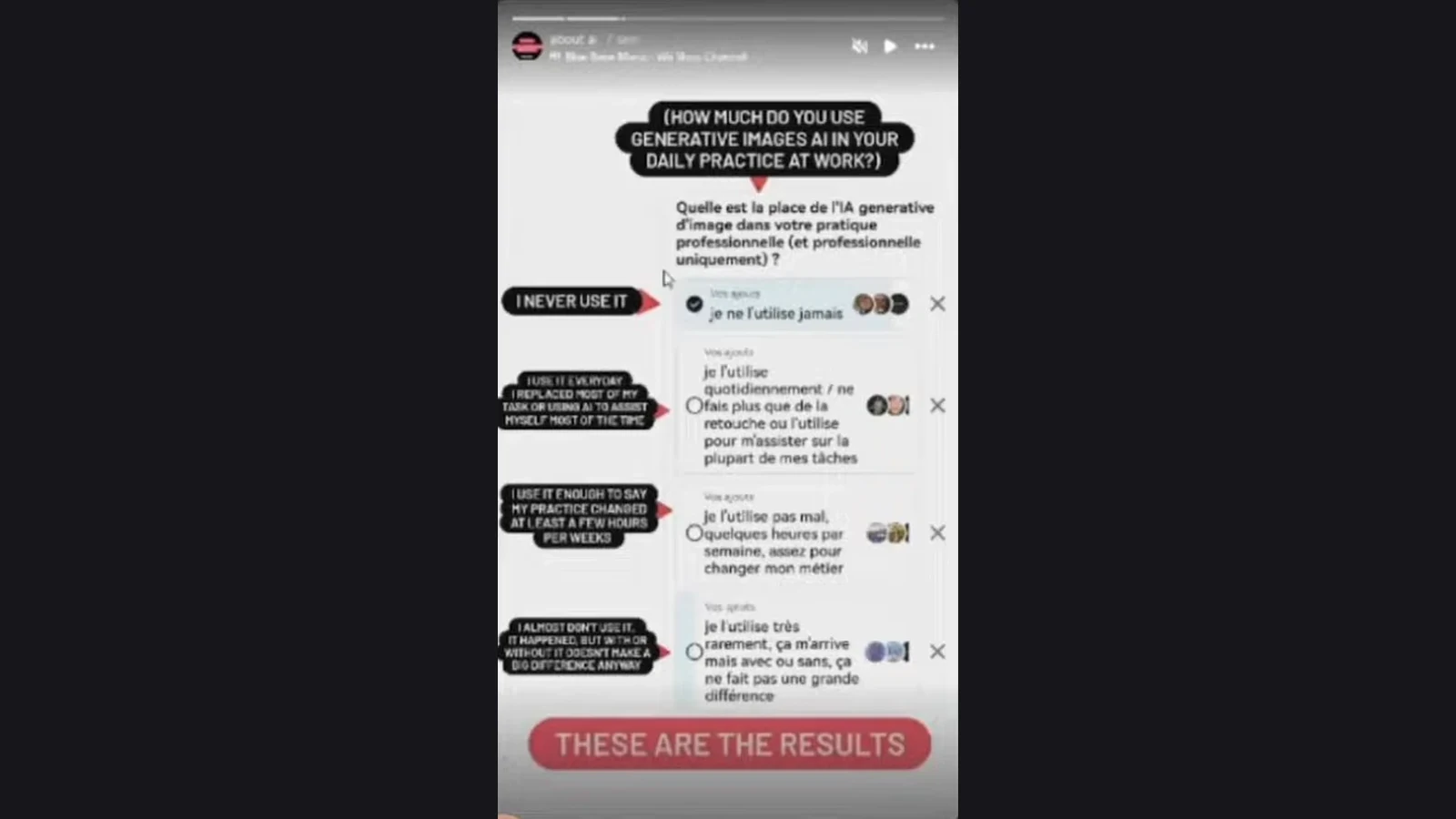
Since his experience “is only his own”, he ran a poll in 2025 in an animation Facebook group with over 10,000 members, compared with the roughly 10,300 people employed in the French industry (59:07). Only people who had been employed in the sector the previous year were asked to answer. The question covered professional use of image-generating AI in the broadest sense: backgrounds, color, inbetweens, moodboards (1:00:37).
About 1,000 people responded, roughly 10% of the sector’s workforce (1:00:56). The results, as Adrien recalls them from memory during the live session:
- Over 90% never use it in a professional context (1:01:07).
- Six to eight people use it every day and say it has changed the way they work. Adrien himself hesitates between the two figures (1:01:15).
- Four or five people use it a few hours a week, enough for it to have an impact on their job (1:01:51).
- Around sixty people, or 6 to 7%, use it rarely, without it making much difference: some feel a Google search would have given them the same result (1:02:13).
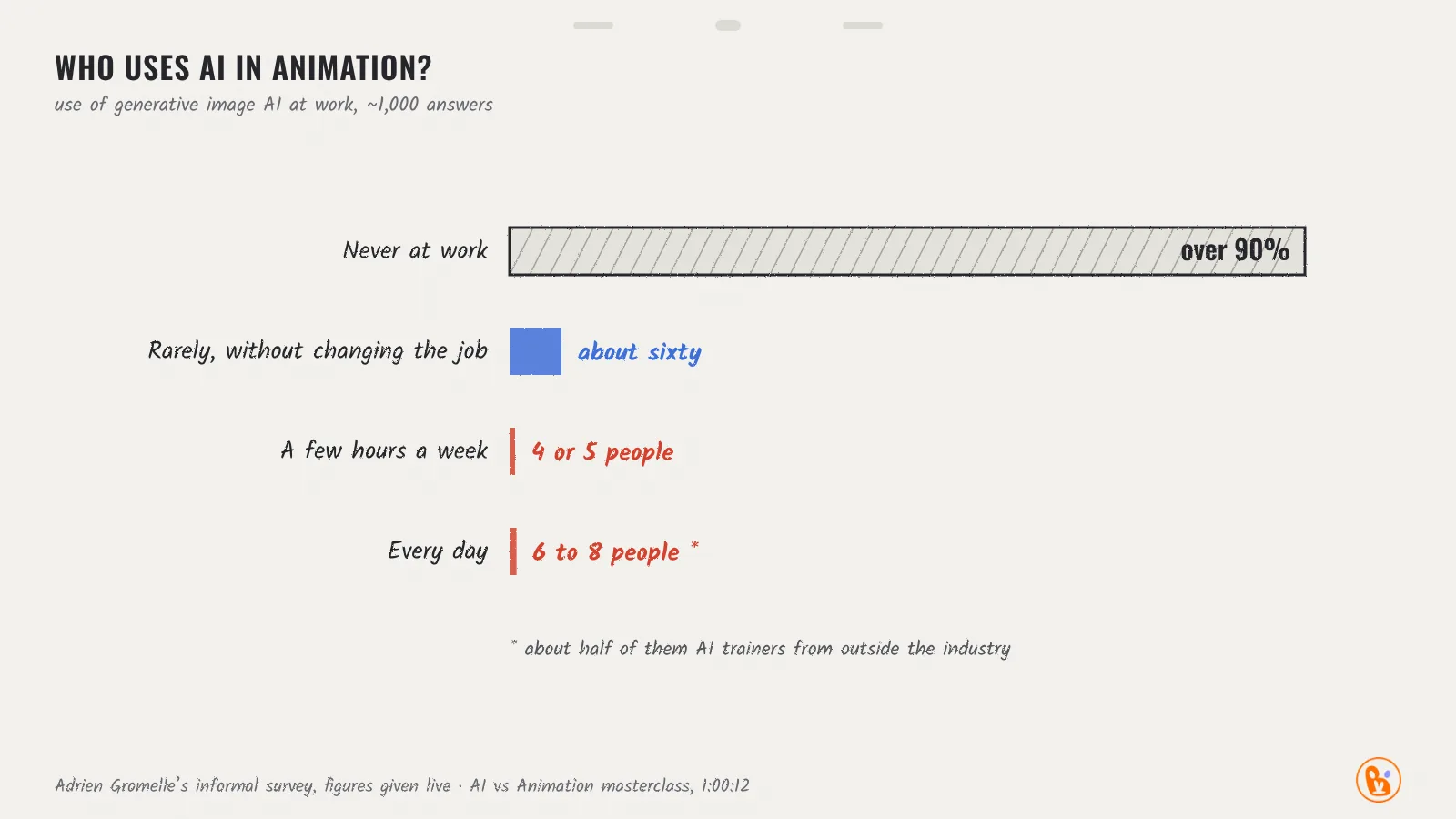
The poll was not anonymous, and that was deliberate. Among the daily users, half were AI trainers who, judging by their CVs, hadn’t released anything in cinemas, on TV or on a streaming platform in years (1:02:41). His conclusion, at the end of the live: “Out of 1,000 people, six use it, and three of them aren’t in the industry” (1:29:32).
These numbers have their limits: a Facebook group is not a random sample, and the results are quoted from memory. They also date from 2025: the tools and the way people use them have very probably changed since. For Adrien, that does not change the core point: asking an AI to produce a movement or to inbetween between poses has little to do with the practice of animation. Nor does he claim that nobody is affected: in his view, illustration, advertising and motion design are probably hit much harder than animation, although he has no figures for those fields (1:04:00).
Why AI can’t animate
For Adrien, the question isn’t a technical one: it comes down to what the job actually is. Whatever the technique (2D, 3D, stop motion, pinscreen), animating means taking the time to give every single frame an intention (06:04).
“What’s different about animation is that we get a long time to handle a short time.”
Adrien Gromelle, AI vs Animation masterclass 07:04
An actor performs in the moment. The animator, on the other hand, builds the character’s thought process frame by frame, to keep as much control over it as possible. Generative AI aims for the exact opposite: speed (07:36).
Animating isn’t just moving things around
“Animate” comes from anima, the soul: it means making a character think, feel and live, not just move from A to B (12:01). Adrien has a word for everything else: “bougisme”, roughly “movement for movement’s sake”. The word is not aimed at AI alone: an animator can perfectly well inbetween mechanically between keys and animate nothing in a movement.
“If you make characters move without caring about their emotions, their thoughts, their past, the context, then you’re not even doing animation, you’re just doing bougisme.”
Adrien Gromelle 21:16
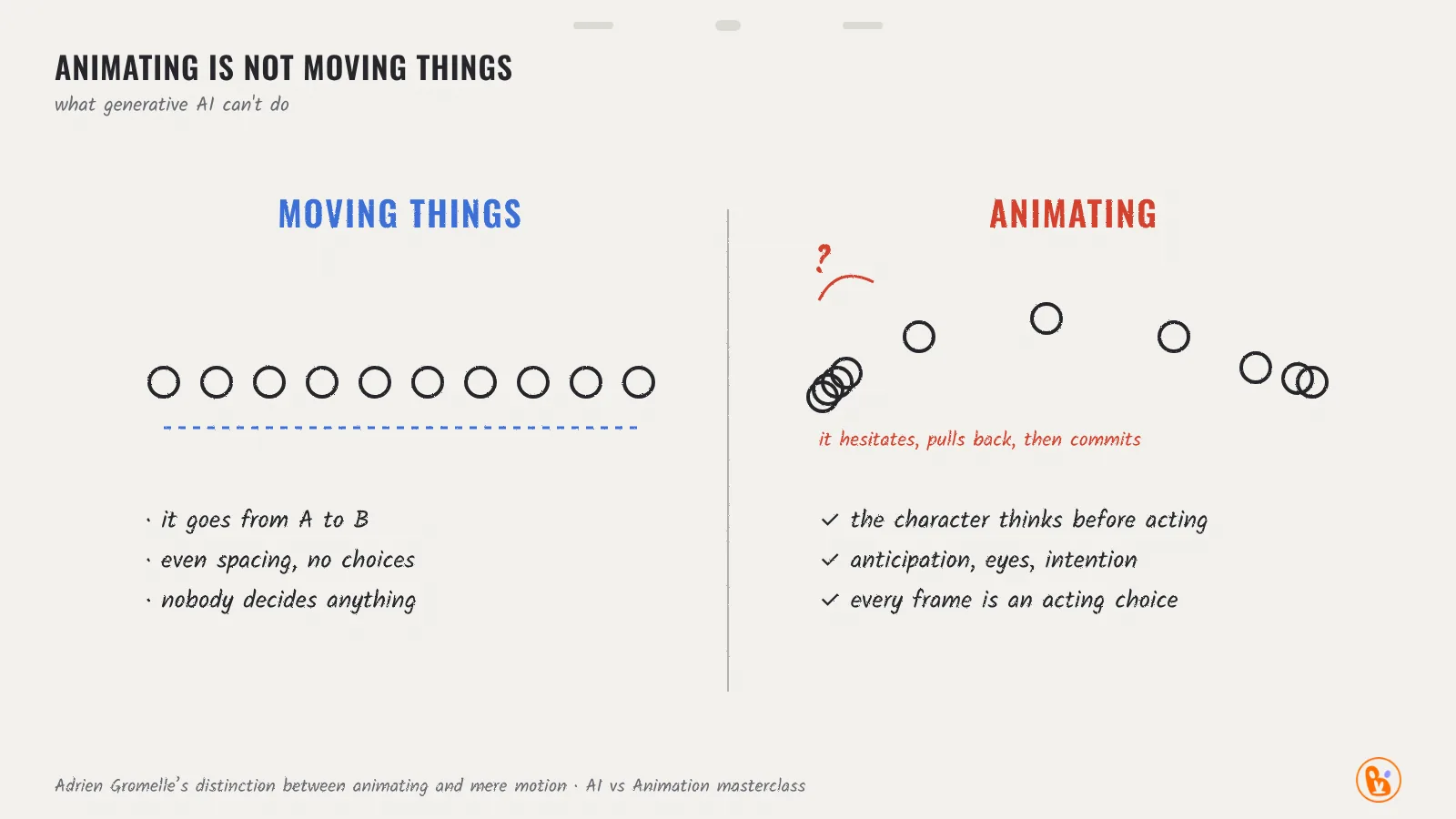
When a character has to cry, the animator draws on memories, personal experience and a part of the unconscious. They feel the emotion in their body, a discomfort, shoulders tensing up, and draw it “by feel” (15:14). And, as he points out, “when you write a prompt, you can’t write the unconscious” (13:23).
A “statistical” AI, not an AI that understands
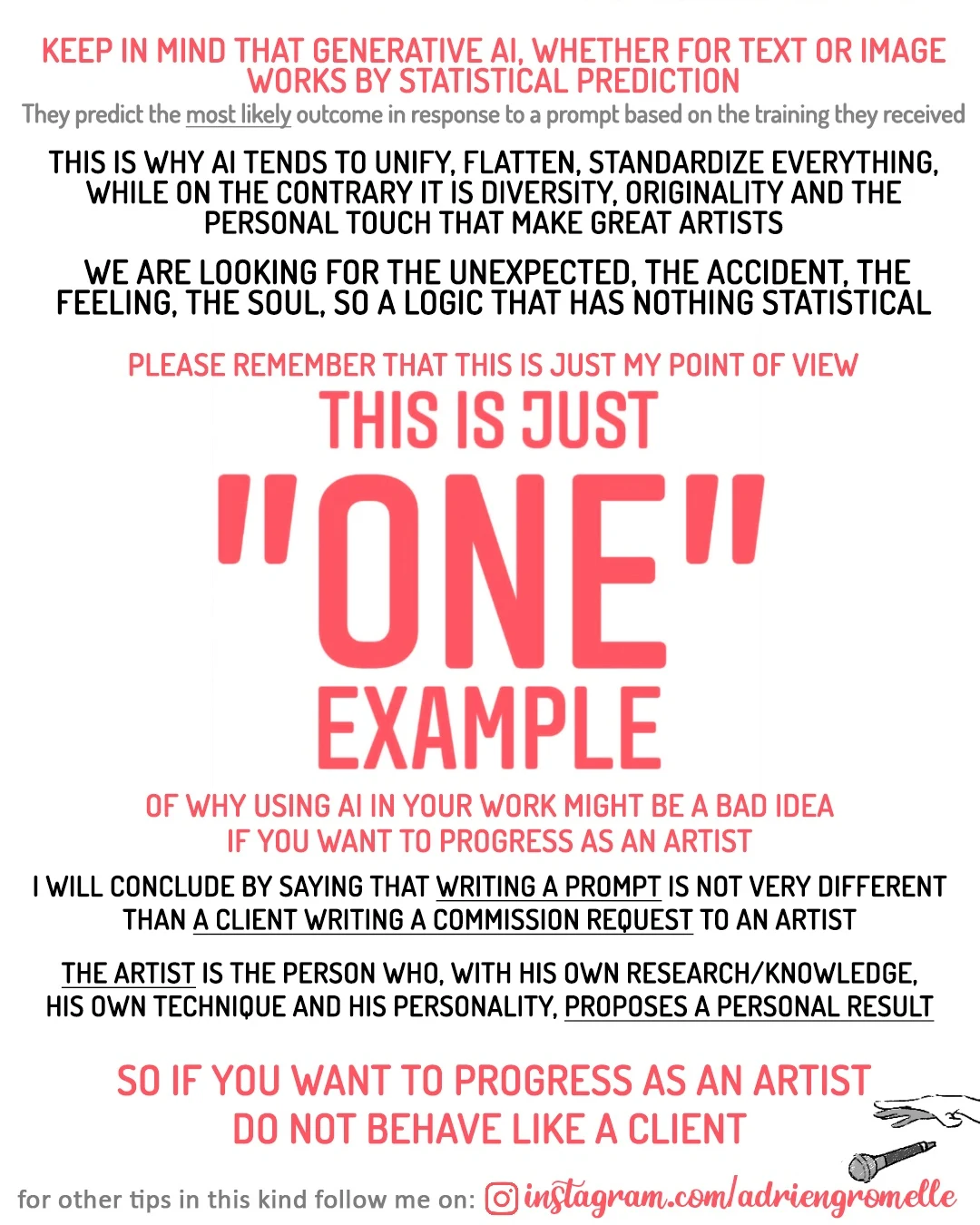
Adrien separates two families. Today’s generative AI is, in his view, statistical: it pulls elements linked to keywords from its database (a man running, a dog, a beach) and recombines them (17:50). It has no idea whether the person filmed in its training data was hungry, or what being hungry even means. The result: it returns the most expected answer, like a Google search, whereas the same prompt given to several artists produces very different work (10:16). That’s exactly why, in a studio, shots are cast according to each animator’s sensibility (43:38).
What AI might be able to do one day, he concedes, is crowd bougisme: extras clapping in the background. Even there, he hasn’t seen anything clean lasting more than 3 or 4 seconds without morphing: if an intern handed that in, it “wouldn’t get approved” (21:59).
What people who disagree say
Several participants in the live session argued the other side. Viewers only see the final result, not how it was made; and clients will go for the cheapest option, even if the quality is lower (51:27). Adrien’s answer is that the result has to be good enough, precisely: an actor who recites lines without feeling them loses the audience within four seconds (23:27). And the clients switching to AI, in his view, are mostly the ones who would never have paid artists anyway (51:45).
He also insists he isn’t against progress: he welcomed 3D “with open arms” and would gladly welcome ethical AI tools that leave the artist in control (28:32). He even considers some VFX uses legitimate: putting an actor’s face on a stunt double, a compositing task that doesn’t replace any artistic performance (48:26).
Will AI replace inbetweening and cleanup?
It’s the most common argument: AI will at least take over the work seen as “less fulfilling”, the inbetweens (53:57). Adrien points out that tools able to turn a 12 fps video into 60 fps already existed in 2010, with a script available for After Effects (54:26). If they aren’t used, it’s not for lack of means: it’s because frame count isn’t what makes animation.
On the ground, he mentions the French studio Je Suis Bien Content, with whom he worked on My Father’s Secrets (Les Secrets de mon père), which still has its assistant animation done by humans (55:25). He also knows two or three studios that tried AI projects: they either shut down before the end, or the project cost more for a worse result (56:14).
90% of AI-inbetweened shots sent back
Account from a participant in the live session: on a recent production, nearly 90% of the shots inbetweened with AI by a partner studio abroad were sent back, because they didn’t match the animation (56:51).
Adrien takes the opportunity to stand up for cleanup, which he considers undervalued given the skills it requires. For him, it’s one of the best ways into the industry (57:30).
“You can’t be a really good animator without enough experience in cleanup.”
Adrien Gromelle 57:47
Copyright and plagiarism: why studios are wary
The first problem Adrien raises: generative AI is built on images and sounds that aren’t royalty-free, used without their creators’ consent. “If a human did exactly what AI does, that human would be convicted” (27:05).
He shows generated characters that blatantly plagiarize Mario. The example is deliberately obvious, but what isn’t blatant isn’t any more legal: an AI-generated image isn’t royalty-free (32:26). He takes the reasoning further: the more emotionally accurate a result is, the more faithfully it copies some original content, so the closer it gets to plagiarism (47:51). He illustrates this with a generated ad for a fast-food chain, almost shot-for-shot identical to a real ad filmed earlier, which was then pulled (1:24:23).
These are the reasons, he says, why AI isn’t used in studios: nobody knows where the image comes from, and there’s a fear it will “come back” to bite the production (1:14:33). As a former jury member at Gobelins, one of France’s best-known animation schools, he used to hunt for plagiarism in applicants’ portfolios: two portfolios with the same drawing, and neither candidate got in (1:12:39). Hence his very critical view of schools launching AI courses.
The real problem with junior jobs
Adrien doesn’t deny the crisis, but he sees other causes. First, a production bubble during Covid, followed by a drop in streaming platform funding, with many projects cancelled (1:06:51). He also argues that Disney has a lot of work produced in France, partly because copyright law is stricter there and AI isn’t used (1:07:37). That’s his analysis, not a verified figure.
Next, despite the recent downturn, employment in animation is still, according to him, well above 2015 levels (1:08:42). So why are so many juniors out of work? His answer comes down to the number of graduates:
- About 500 students graduated each year in 2015, “I think”, he adds (1:09:26).
- About 3,000 a year today, a figure from 2023 or 2024; he’s no longer sure which year (1:09:16).
- About 10,000 people currently employed in the French industry.
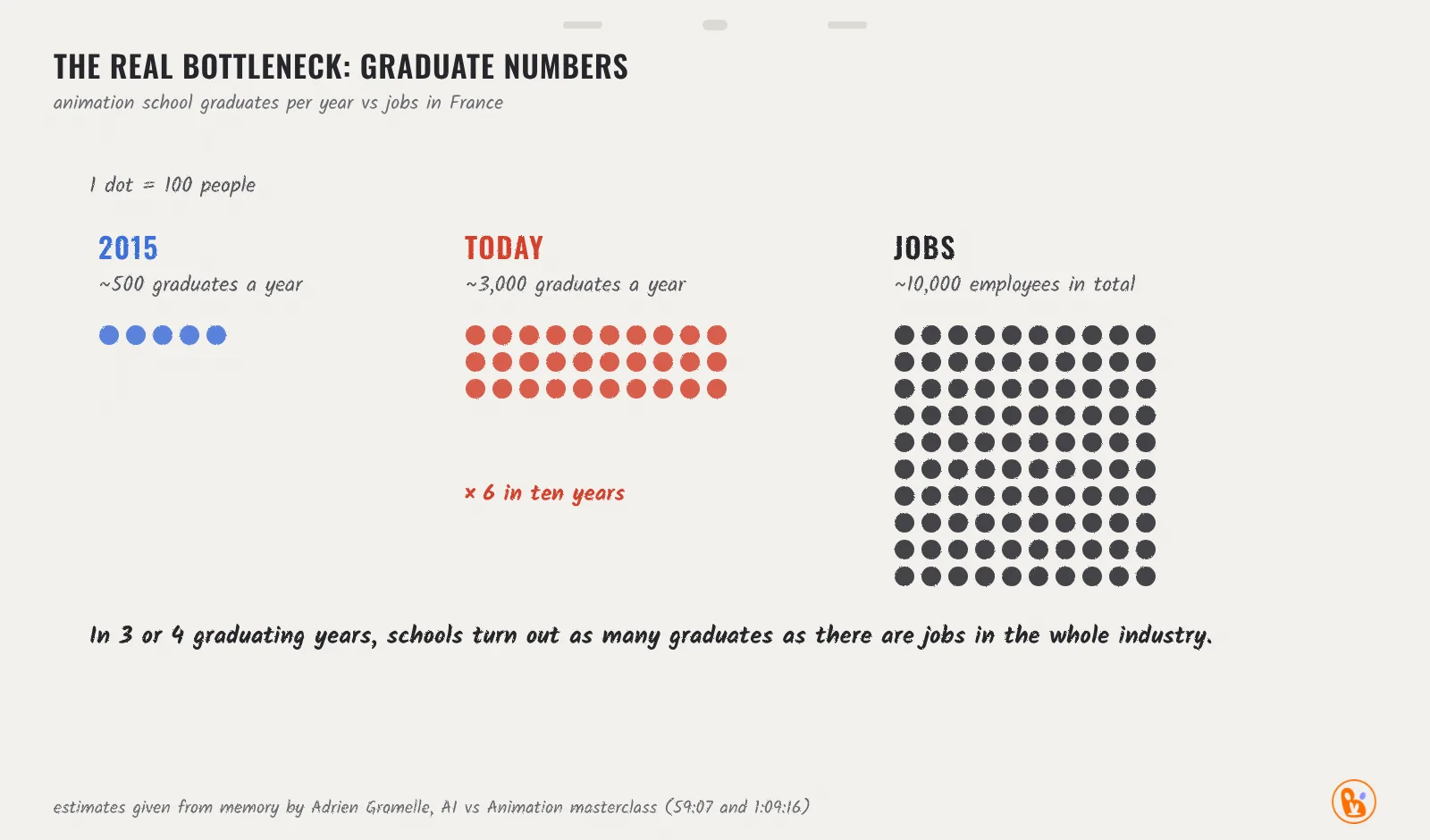
His math: at this rate, in three or four years, schools turn out more graduates than the industry has employees (1:09:44). Even with production on the rise, less experienced juniors struggle to find their place, often with a student loan to pay back (1:10:15). He made the same point in his masterclass on production, where he mentions studies published by the CNC, France’s national film and animation agency (1:17:33), and the vicious circle that follows: juniors with their backs against the wall accept poorly paid jobs with impossible deadlines.
“We have juniors who get fired because people think they’re bad, when in fact we just put them in conditions where they didn’t have time to get good.”
Adrien Gromelle, Every production is a miracle masterclass 1:01:04
So why does AI seem to be everywhere? Adrien films his Instagram feed live: about one post in three is sponsored, and nearly all of those sponsored posts push AI tools or AI courses, even though he has been flagging them as “not interested” for months (1:19:21). For him, AI is overrepresented on social media, not in the industry. He wraps up unworried, at least as far as AI is concerned: “Three years ago, people were telling me I’d be replaced within six months” (1:29:22).
Should you use AI while learning animation?
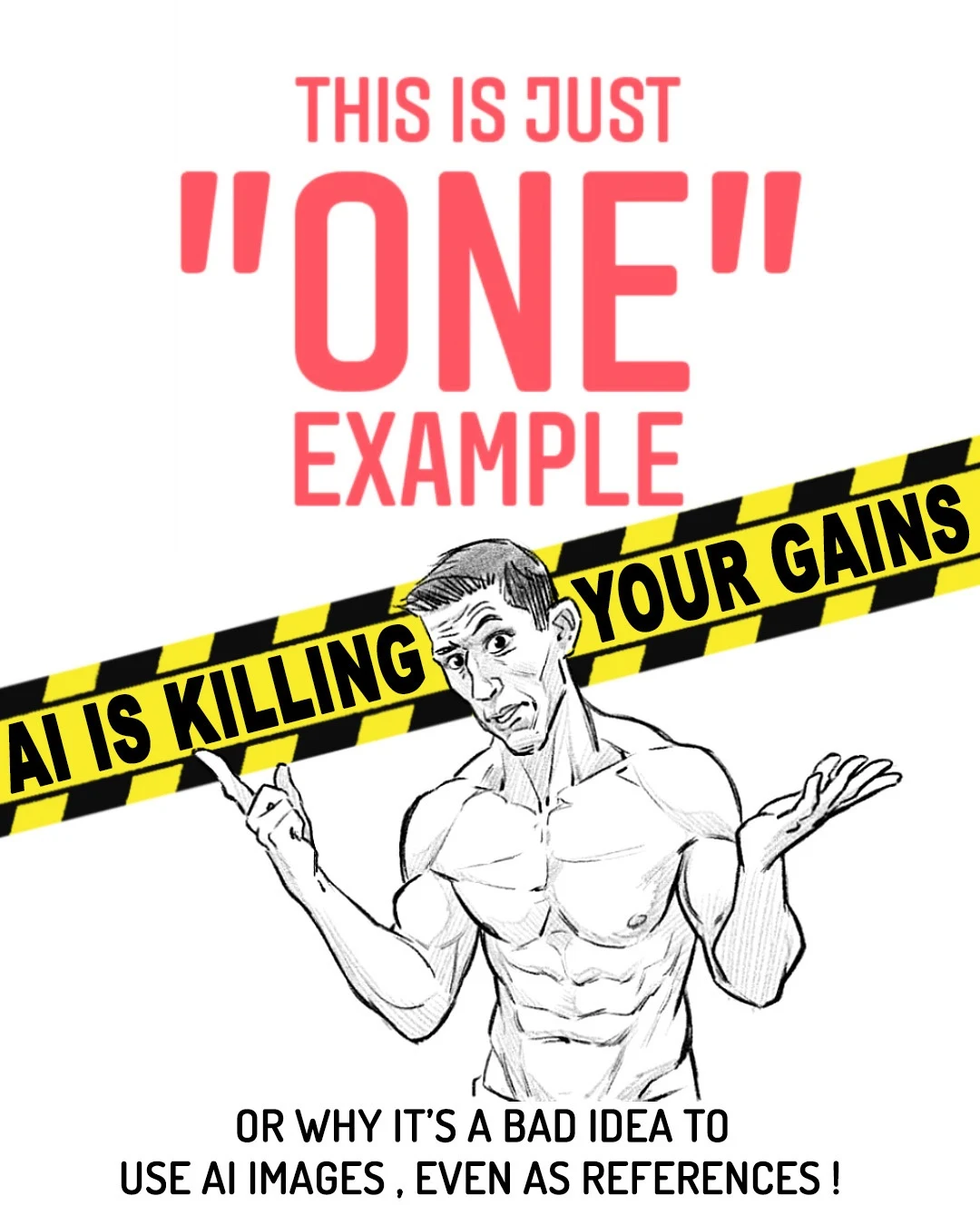
Adrien doesn’t rule it out: you can be inspired by any image, including a generated one. But he draws a distinction: “The client asks, the artist proposes.” Writing a prompt puts you in the client’s seat, not in the role of the one making proposals (44:54). Hence his advice for learners: if you want to grow as an artist, don’t position yourself as a consumer (45:54).
For reference, a generated image is at best as good as a Google search, minus the source (1:27:22). With Google, you find the author, their whole body of work, their approach, and you can figure out what it is you like (33:03). Same thing for anatomy: an AI filter interprets shadows without understanding muscles, bones and tendons, and ends up putting the serratus on the abs (38:25). You’re better off studying a real photo with an anatomy book, until you no longer need it.
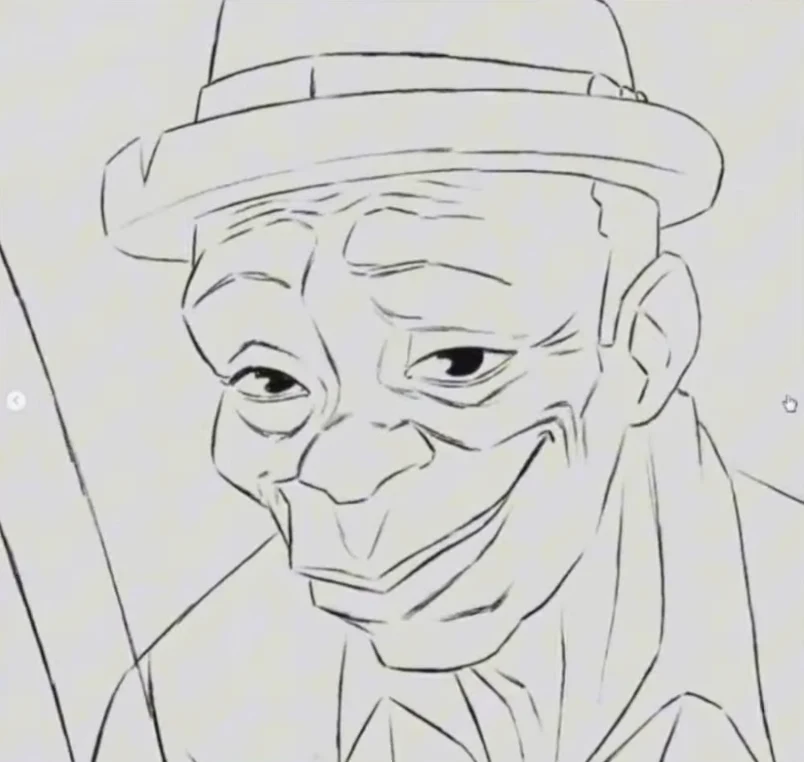
In his masterclass on the blank page, he extends the reasoning to writing: you can ask ChatGPT for a story, and you’ll get “every cliché in the book”. “What we want is you”, what you’ve lived through that nobody has seen anywhere else (35:57). He also explains how he shifted the art direction of a personal project toward a scratchy, organic line, imperfections included, precisely because we’re living through an era of very artificial-looking visuals (1:18:26).
In a nutshell
- AI is rarely used in studios: in Adrien’s 2025 poll, over 90% of the roughly 1,000 respondents never used it professionally.
- The few daily users amount to six to eight people, half of them AI trainers working outside studios.
- Animating means giving every frame an intention. Moving things without thought or emotion is just “bougisme”, whether an AI or a human is doing it.
- An inbetween isn’t an average of two drawings: interpolation tools have existed since 2010 and aren’t used.
- A generated image isn’t royalty-free, and that’s one of the reasons studios avoid it.
- The junior job crisis comes mainly, according to Adrien, from the number of graduates: about 3,000 a year for about 10,000 jobs.
Advice for learners
If you’re learning animation today, here’s what we take away from Adrien’s advice:
- Keep coming up with ideas
Your life experience, your happy accidents and your interpretation are what make you valuable in a studio. - Find the source
For your moodboards, trace things back to the original artist rather than settling for an image with no author. - Don’t overlook cleanup
It’s a solid way in and a great school for the rules of animation. - Keep your portfolio clean
No images whose origin you can’t vouch for: school juries and studios are on the lookout for plagiarism.
These are the views of a working professional, presented as such. The poll figures are indicative and date from 2025.
FAQ
Will AI replace animators?
Not in the short term, according to 2D animation director Adrien Gromelle. In his 2025 poll of around 1,000 people working in French animation, over 90% never used generative AI at work. In his view, AI produces movement, not animation.
Do animation studios use AI?
Very little in France in 2025, according to Adrien’s poll: a handful of people out of 1,000 used it every day, and about 6 to 7% rarely. Copyright concerns also hold back its use.
Will AI replace inbetweeners in 2D animation?
Interpolation tools have existed since 2010 and aren’t used in production, because an inbetween requires choices about volume, arcs and spacing. A participant in the masterclass mentions a production where nearly 90% of the AI-inbetweened shots were sent back.
Is it hard to get a job in animation?
For juniors in France, yes, and according to Adrien Gromelle’s analysis the main reason is that the number of graduates has soared: about 3,000 a year (a 2023 or 2024 figure) versus about 500 in 2015, for about 10,000 jobs.
Can I use AI images in my animation portfolio?
It’s risky. A generated image isn’t royalty-free and may copy another artist’s work. School juries and studios actively hunt for plagiarism.
Everything you have just read, our mentors put into practice every day on feature films. To go further, they guide you in small groups through our professional training programs, shot by shot, with the standards of a real production.