Animation demo reel : how long it should be, what to put in it and mistakes to avoid
How long should an animation demo reel be? What should you put in it when you are just out of school? Adrien Gromelle, an animator and 2D animation director on feature films and series, has sat through reels one after another to hire people. His answer is short: 45 seconds can be enough for a junior, as long as every shot is one you stand behind. With Samy Fecih, a 3D animator, and Pierre-Baptiste Marty, founder of Bouncing Ball, he also makes a bet: originality counts for more than technical feats. A 45-second blocking was enough to open Pixar's doors.
 By Bouncing Ball
- 12 min read
- Level: Students, juniors looking for work
In this article
- How long should an animation demo reel be?
- What to put in an animation demo reel
- School exercises and personal projects: what is acceptable?
- Should you show rough, blocking and process in your reel?
- Why avoid famous film references in your demo reel?
- What recruiters really look for in a junior animator
- When should you send your demo reel to a studio?
- In a nutshell
- Before you send your reel
- FAQ
How long should an animation demo reel be?
The question came in through the chat at the end of a masterclass on quotas: when do you know you are ready to send your reel to a studio, and what should it contain (1:09:17)? Adrien Gromelle spent about ten minutes on it, starting with length.
His numbers: 1:30 to 2:00 is the right length for a demo reel. For a junior, 45 seconds can already be enough. And going past 2 minutes serves no purpose (1:12:44). He uses his own reel as a counterexample: just over 2 minutes, “already very long for a demo reel” (1:13:03).
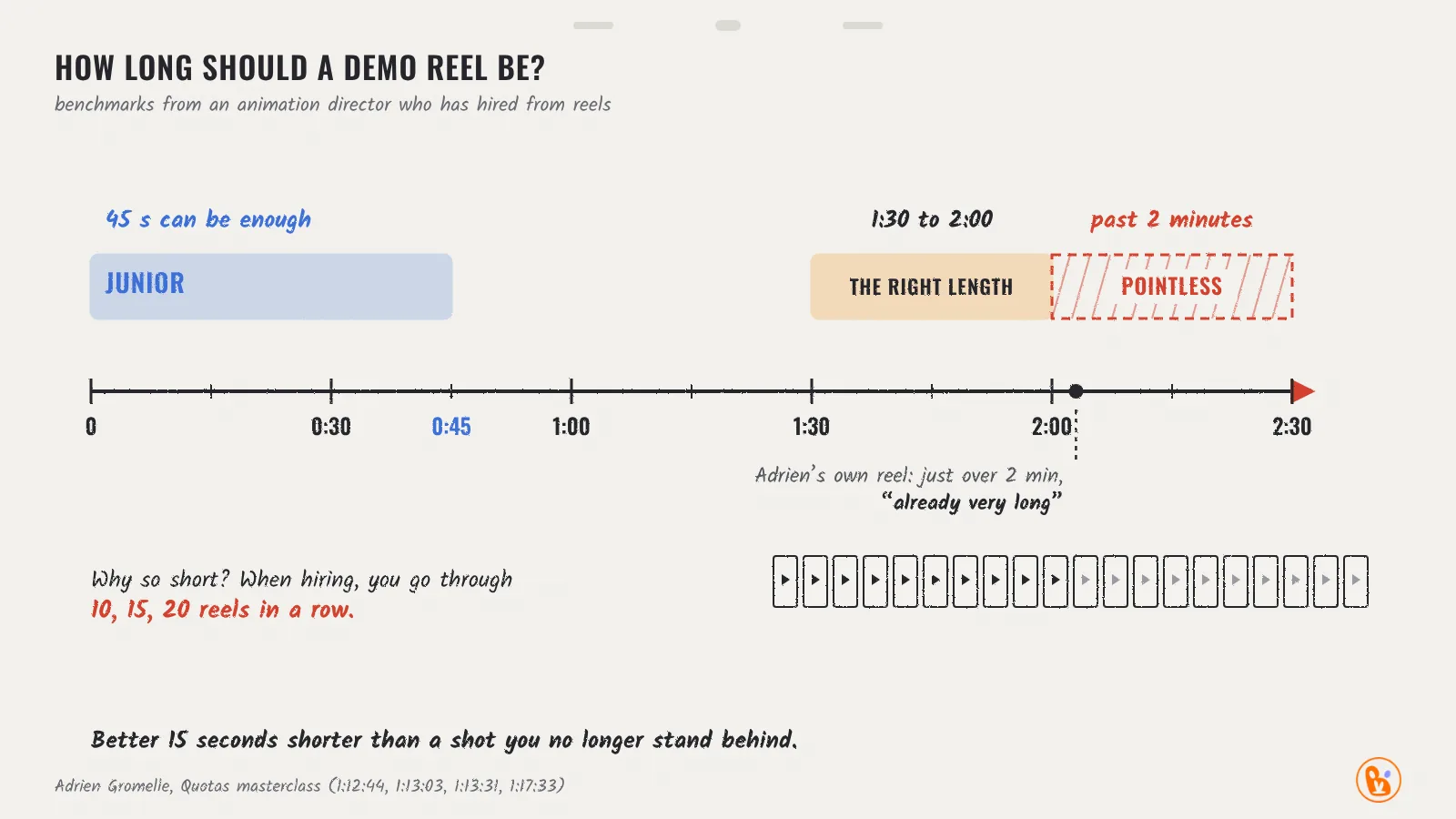
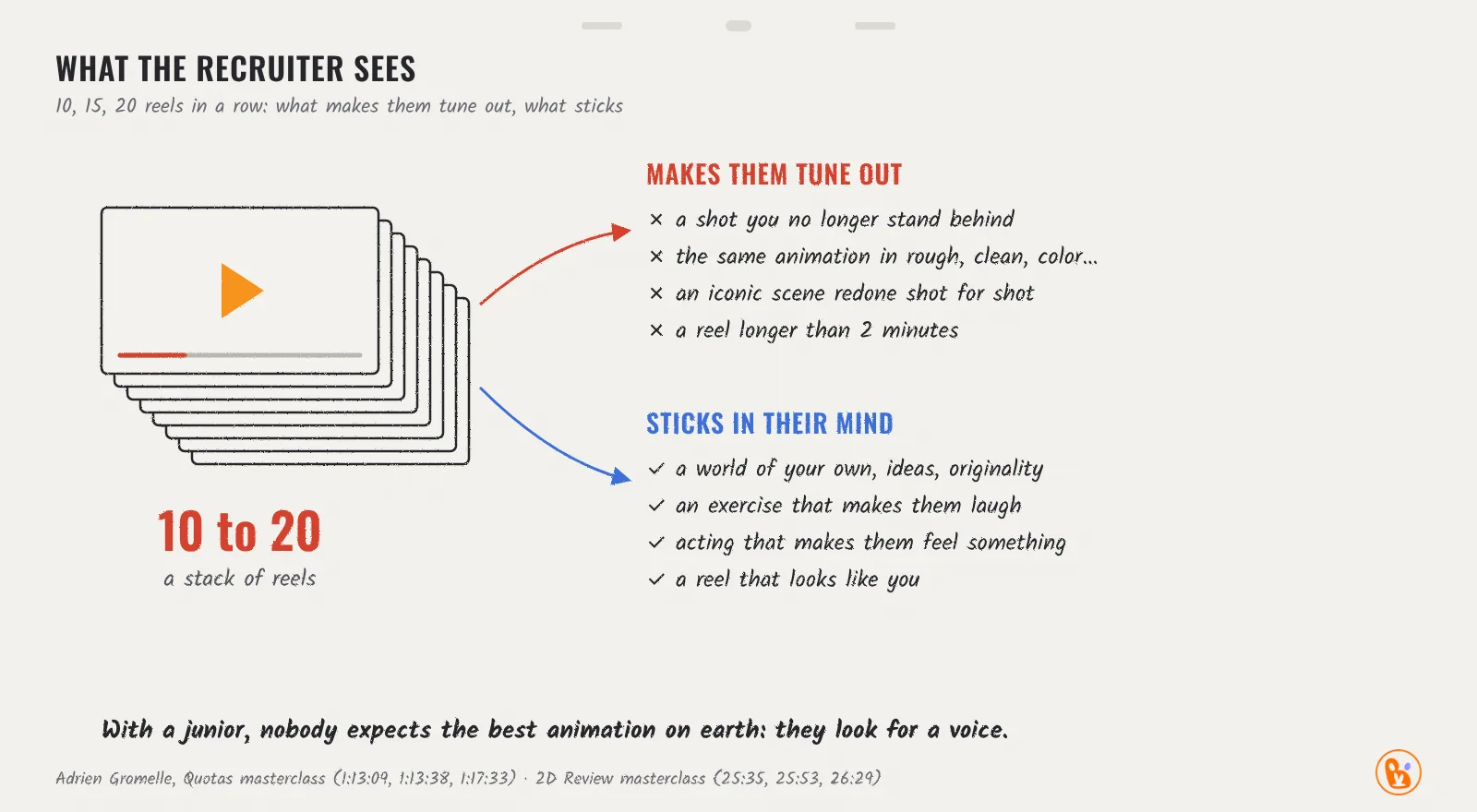
Why so short? Because the person hiring doesn’t have one reel to watch, they have a stack. Adrien speaks from experience: “when you’re hiring,” he says, you have “10, 15, 20 demo reels to watch” (1:17:33). Once your level is clear, every extra second works against you.
“There’s nothing worse than being bored watching a reel where you want to scroll to get to the end, because that’s it, you’ve understood the person’s level.”
Adrien Gromelle, Quotas masterclass 1:17:21
His rule of thumb is simple: a reel that is 15 seconds shorter beats one with a shot you’re not proud of (1:13:31).
What to put in an animation demo reel
The first criterion comes before variety: only include shots you stand behind (1:13:09). Adrien mimics the student who justifies a weak shot: “I put that one in because I needed a quadruped walk, but I did it in 2017, I wasn’t very good, and now I don’t stand behind it.” His answer: leave it out (1:13:21). In his words, a reel should be “a perfectly balanced cocktail.”
A bit of everything, or a reel that looks like you?
Adrien endorses the classic advice: ideally, show a bit of everything to prove you’re versatile. Action, lip sync, acting, characters moving through space (1:10:09). “That’s the dream.” He admits it is fairly good advice (1:14:23).
But he immediately adds that your reel should look like you (1:10:26). His own is full of dance, capoeira, choreography and fights, with little acting, even though he loves acting (1:11:22). The reason was practical: when he cut it, around 2017, none of his acting and lip sync work could be shown yet (1:11:42). The bet paid off: “people often came looking for me for that” (1:15:04). He is careful to say it isn’t automatic, and that if you don’t have a strong personal touch yet, the most versatile reel possible is “very good” (1:15:10).
He also suggests tailoring your reel to the job, for example by showing more acting for a project that calls for it (1:12:00).
Back-to-back shots or almost a short film?
On format, Adrien offers a view he calls subjective. Many people will tell you a reel is not a short film: no music, just shots one after another, “and that’s it” (1:10:39). He edits his to music, with intercutting to build attention and transitions between shots (1:12:30). His goal: the recruiter “doesn’t have time to get bored” (1:16:59). He doesn’t claim it’s the only way. The takeaway is the intention: a reel gets watched to the end, or it doesn’t get watched.
School exercises and personal projects: what is acceptable?
Is it a problem if most of your reel is made of school exercises? No, says Adrien (1:17:52). Your reel can contain only school work, or none at all. What matters is that it’s interesting, tells something, carries an emotion, and that you stand behind it. Above all, it has to reflect your actual level (1:18:17).
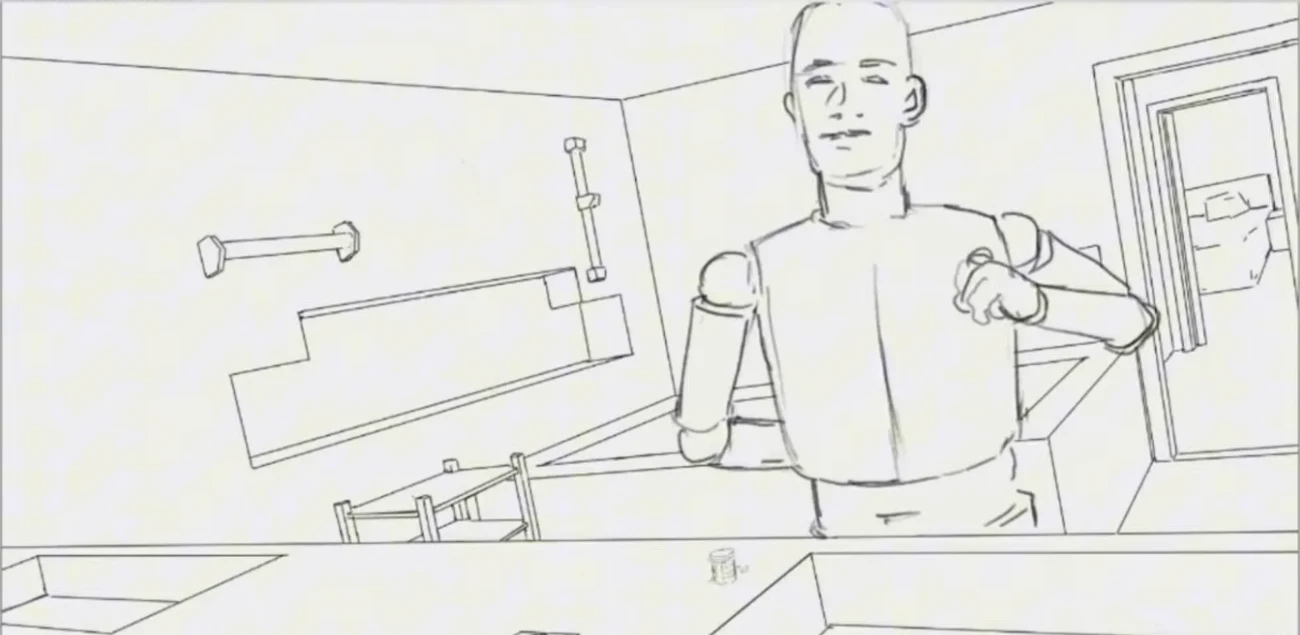
Personal projects play a specific role. Adrien recommends setting yourself an overall deadline rather than quotas, for instance so a shot is ready for your reel when you graduate (1:19:00). In another masterclass, he explains why they stay useful even once you’re employed: an animator who has only worked in TV series will need to spend time on more ambitious shots, because a reel made of series shots probably won’t be enough to land feature film work (36:39).
Samy Fecih adds a return-on-time argument. She understands the logic of reanimating a shot from a professional film, but she’s “not a fan”: it’s a shame to spend weeks on a shot you can’t put in your demo reel (31:08). To learn from a film, she prefers to study it frame by frame (31:25), and she advises against copying an animation you won’t even be able to put in a reel afterward (34:12).
Should you show rough, blocking and process in your reel?
Short answer: no. Adrien is explicit. Don’t put the same animation in once as rough, once as tie down, once as clean, once in color and once with compositing (1:13:38). If you did it all, show the finished, composited animation. Showing the same animation three or four times to pad the reel “shows” (1:14:04). The only exception: cutting one animation into pieces for intercutting.
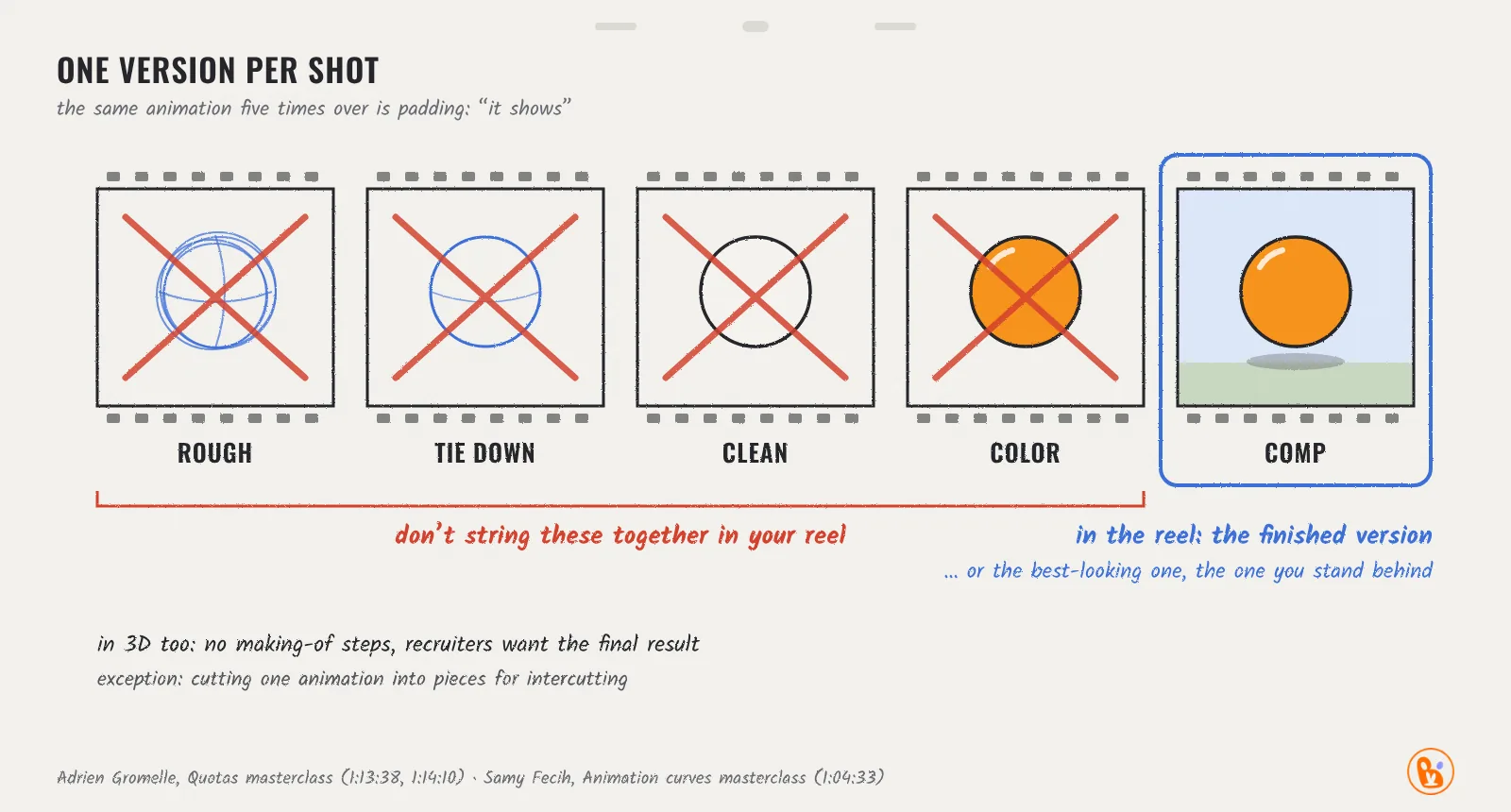
Which one to keep? The one that looks best to you and that you stand behind. If your clean is a bit off but the animation is good, keep the most successful version (1:14:10).
Samy Fecih says the same from the 3D side. Answering a question in the chat, she says there’s no point showing the making-of steps: recruiters just want to see the final result (1:04:33). She doesn’t see the point of including an animation in blocking plus either, unless it isn’t finished (1:03:12).
A 45-second blocking that got into Pixar
Samy tells the story of a friend who studied with her at Animation Mentor and landed a job at Pixar with a blocking in his demo reel. The blocking was 45 seconds long, and the acting was “incredible” (1:03:17).
The story doesn’t contradict the rule, it explains it. What won them over wasn’t the production stage, it was the performance. As Samy puts it, going to spline is “purely technique,” and anyone can help you fix it. Having good ideas and good intentions, on the other hand, “is something that comes from you” (1:03:31). For more on the difference between these two stages, see our article on going from blocking to spline.
Why avoid famous film references in your demo reel?
While reviewing student animations, Pierre-Baptiste Marty, founder of Bouncing Ball and a 3D animator, shares advice he often gives his students: be careful with references that are too well known (21:03). When the film is very famous, you know exactly where you’re going, you can’t break free from the original audio, and you end up creating less. What looked like a shortcut becomes an obstacle. His advice for personal projects: ideally, don’t even watch the original shot before you start animating (21:40). The exception is a purely technical exercise, where you want to reproduce a specific camera move. Then you’re practicing scales, not doing artistic research (21:53).
With a famous reference, the hosts go on, you only have two options (25:15):
- Do the same thing, but better than the original. You’re handicapping yourself from the start: everyone is waiting for you to slip, and you’re judged by comparison.
- Make it your own and turn it into something funny. The exact opposite happens: recruiters remember you.
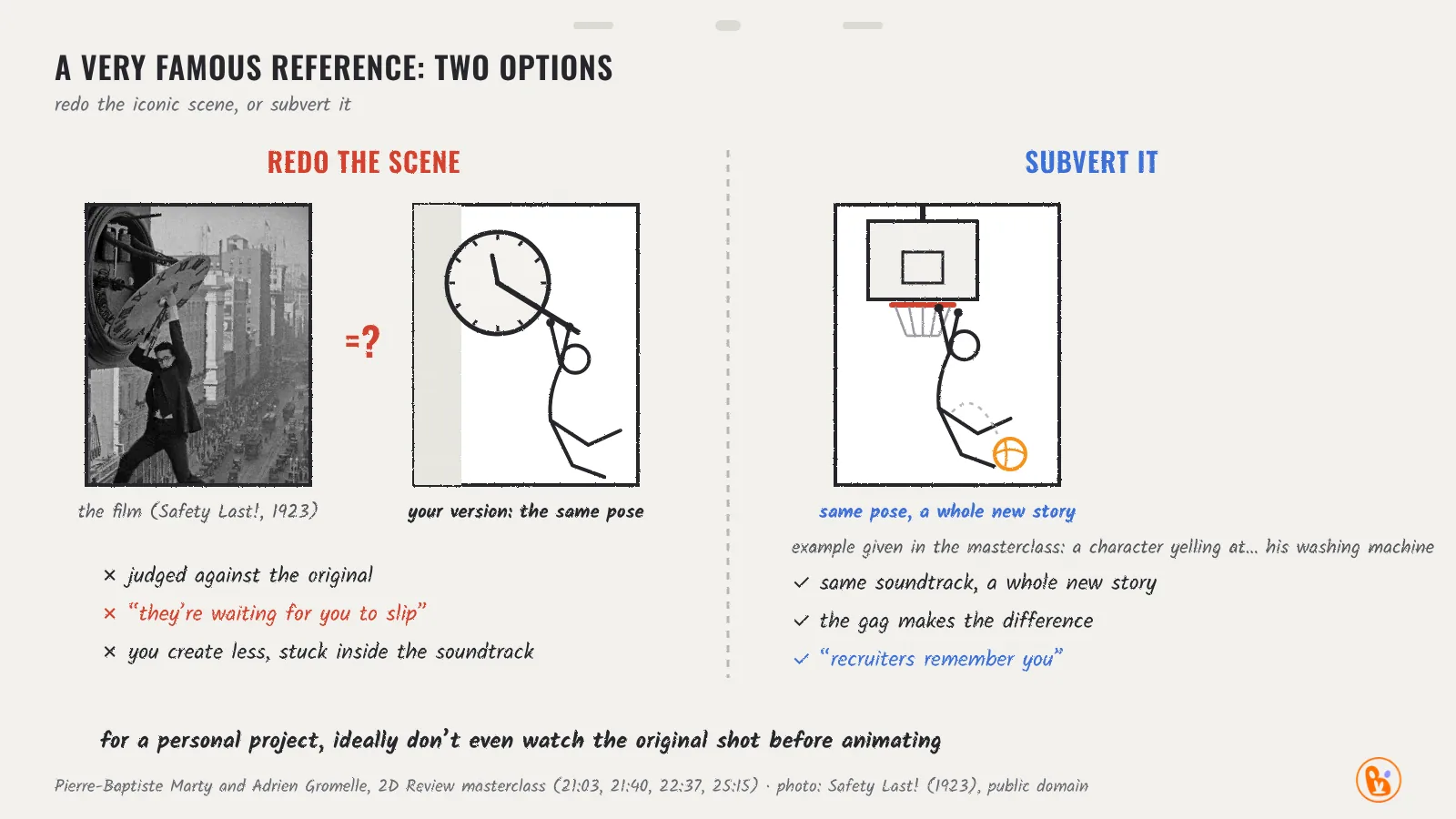
The example given live is an exercise animated by Johan Herveau when he was at Gobelins, around 2009 or 2010 (22:37). He used the tall, lanky henchman from 101 Dalmatians, Jasper or Horace, who chews someone out off screen for thinking only of himself and leaving him in a mess. At the punchline, he drops what he’s holding: it’s a pair of pants, and he’s yelling at the washing machine that shrank them (23:51). Same soundtrack, a completely different story. The conclusion: you’re allowed to use very well-known material, as long as you subvert it enough to have something of your own to say (24:50).
And it matters when reels are being sorted. “I’ve seen so many demo reels I’ve lost count,” one of the hosts says during the review. An exercise that makes you laugh “can make the difference on a reel,” simply because the recruiter will remember it (25:35).
What recruiters really look for in a junior animator
Nobody expects flawless animation from a junior. What they look at is something else:
“We don’t expect the best animation on earth from you, you’re a junior. We expect your world, your ideas, your originality, your creativity. That’s what we look for in juniors.”
Adrien Gromelle, 2D Review masterclass 25:53
The advice that follows is practical: now, while you don’t yet have kids and other commitments, is the time to make personal shots and show what you want to show (26:13). With a simple test: if a shot doesn’t make you laugh or cry while you animate it, it probably won’t make the audience feel anything either (26:29). Before spending weeks on a shot, ask yourself why you’re doing it and what you want people to feel (26:42). Otherwise, you risk ending up with a shot that is “technically impressive” but says nothing (26:55).
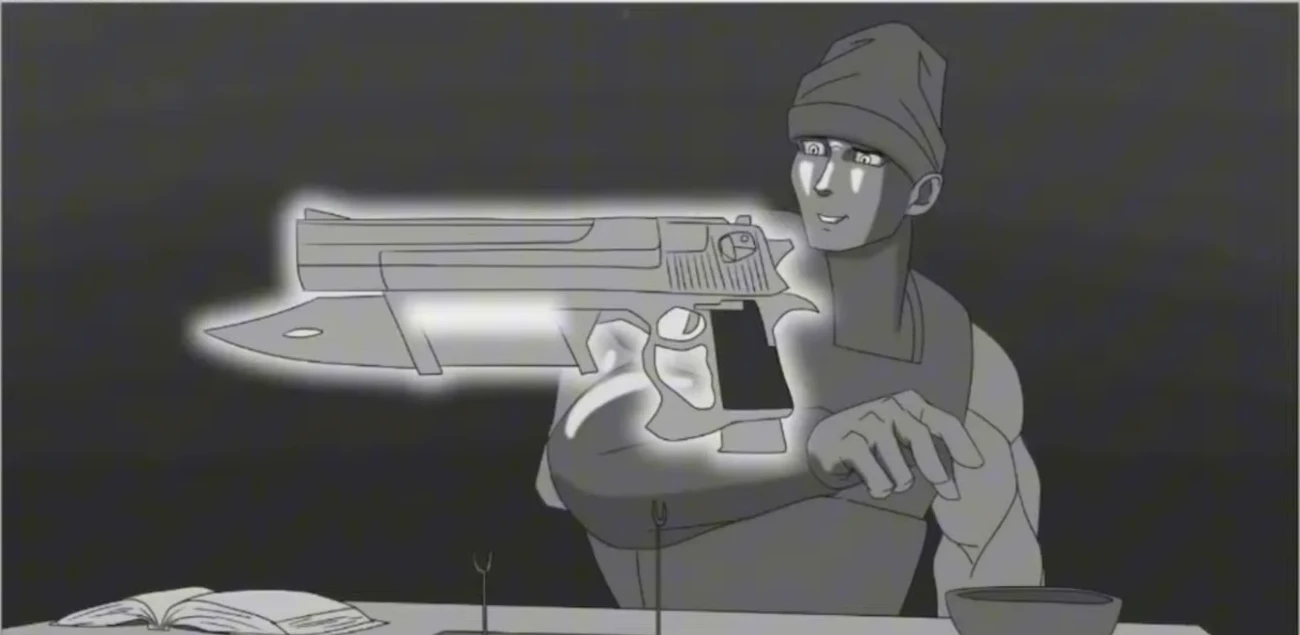
The same review shows it in practice. On the last student animation, Adrien points out “plenty of little technical glitches”: spacing pops, volume loss. But of the three, it’s the one where the most happens in terms of acting, eye direction and intention (46:58).
Your world, not someone else’s
Originality also means not copying. Adrien recalls sitting on the jury at Gobelins, where they hunted for plagiarism in applicants’ portfolios (1:12:39). One day, the same drawing turned up in two different portfolios. There was no way to know who had copied whom, so neither applicant was selected (1:13:06). He explains that a portfolio consistent from start to finish left no doubt about its author, while a single image in a style foreign to the rest cast suspicion on everything else (1:13:25). In schools as in studios, he points out, the goal is to make sure the people you hire are genuinely competent. He applies the same reasoning to AI-generated images, as we covered in our article on AI and animators.
Does that mean you should hunt for a style at all costs? When a student says finding one is “really hard,” Samy Fecih answers the opposite:
“Don’t look for your style. A style isn’t something you look for, it’s something you find naturally.”
Samy Fecih, Testing a rig masterclass 53:49
She never went looking for her own style, which is fairly realistic: it developed as she found out what she liked (54:42). She recommends focusing on intention, on what you want to say (55:08). For her, looking for a style too early means boxing yourself in (56:09).
When should you send your demo reel to a studio?
Adrien’s answer is disarming: when you need to. Every time he sent out a reel, he cut it overnight, “in a panic,” because a position had just opened and they were waiting for his application (1:15:49). That’s usually how it goes, he says.
Waiting until you feel ready leads nowhere: you always want to add a shot, polish something, do better (1:16:13). When an opening comes up, you take it. If a shot has great ideas but you no longer fully stand behind it, and one night is enough to rework it, do it. Adrien has spent five hours reworking an animation, then cut his reel right after and sent it (1:16:42).
The context explains the urgency. According to figures Adrien quotes from memory in another masterclass, about 3,000 students graduate from animation schools in France each year, for roughly 10,000 people employed in the industry (1:09:11). A reel that’s ready to go beats a perfect one that arrives too late. Once you’re hired, other questions come up fast, such as production pace, which we cover in our article on a junior animator’s daily quota.
In a nutshell
- Length: 1:30 to 2:00 max; 45 seconds can be enough for a junior.
- Content: only shots you stand behind. Better 15 seconds shorter than a shot you’re no longer proud of.
- Variety: a bit of everything (action, lip sync, acting, movement) is ideal, but the reel should look like you.
- One version per shot: no rough, tie down, clean and color back to back. The final result, or the most successful version.
- Famous references: subvert them or skip them, or you’ll be judged by comparison.
- With a junior, studios hire a world, ideas, originality. A 45-second blocking with strong acting was enough for Pixar.
- Sending: you’re never ready. Send it when the opportunity comes.
Before you send your reel
Five checks, drawn from Adrien’s and Samy’s advice:
- Time it
Under 2 minutes. Junior: aim for 45 seconds to 1:30. - Cut ruthlessly
Remove any shot you no longer stand behind, even if it fills a gap. - Hunt down duplicates
One version per animation: the final one, or the best-looking one. - Watch it like a recruiter
After ten other reels. If you feel like scrolling, cut. - Check that it looks like you
A world, an idea, an emotion: what people will remember about you.
And if a position opens tomorrow, send it tomorrow.
The screenshots in this article are taken from the 2D Review masterclass by Adrien Gromelle and Pierre-Baptiste Marty, streamed live for Bouncing Ball. The animations shown are student work.
FAQ
How long should an animation demo reel be?
According to Adrien Gromelle, an animator and 2D animation director, the right length is 1:30 to 2:00, and there’s no point going over 2 minutes. For a junior, 45 seconds can already be enough. The reason: a recruiter watches 10, 15 or 20 reels in a row and tunes out as soon as they’ve understood your level. A short reel where every shot holds up beats a long one padded with weaker shots.
What should you put in an animation demo reel?
Only shots you stand behind. Ideally a bit of everything: action, lip sync, acting, characters moving through space. But the reel should also look like you: if you have a personal touch or a specialty, it can take center stage. Avoid filler shots and overly faithful remakes of famous films.
Can you include school exercises in your reel?
Yes, no problem. A reel can be made entirely of school exercises, or contain none. What matters is that the shots are interesting, tell something, carry an emotion and accurately reflect your level.
Should a demo reel have music?
Opinions differ. Many recommend back-to-back shots with no music. Adrien Gromelle edits his to music, with intercutting, so the recruiter never gets bored. He presents it as a personal choice, not a rule.
Can you put blocking in your demo reel?
As a rule, recruiters want to see the final result, not the process, and each animation should appear only once. Yet Samy Fecih mentions a friend who got hired at Pixar with a 45-second blocking: the acting was strong enough on its own. Blocking only belongs in a reel if the performance is outstanding.
Everything you have just read, our mentors put into practice every day on feature films. To go further, they guide you in small groups through our professional training programs, shot by shot, with the standards of a real production.