The animation industry crisis : what is really happening in France and worldwide, why, and how juniors can get through it
Studios in liquidation, layoffs in Hollywood, graduates without a first contract: the animation industry crisis is not just a feeling. But it is not quite the story you usually hear either. Figures from France's CNC and Audiens show French animation employment falling sharply in 2024, then stabilizing through 2025 and early 2026. Above all, they show that juniors are taking most of the hit. We gathered the latest official data, checked every studio closure and every round of layoffs we cite, and set it against the view of two working mentors, Adrien Gromelle and Samy Fecih. Updated October 2026.
 By Bouncing Ball
- 21 min read
- Level: Students, juniors, career changers
In this article
- Is there really an animation industry crisis?
- Animation jobs in France: the numbers from 2022 to 2026
- Why the animation industry is in crisis: the streaming bubble burst
- Animation studios in trouble: verified cases in France
- Animation industry layoffs in the US and beyond
- Juniors and graduates: the first to be hit
- Is AI behind the animation industry crisis?
- Pay, protests, tax credits: what changed in 2026
- Animation industry recovery in 2026: signals to watch
- How to land animation jobs in 2026 as a junior
- In a nutshell
- Your junior action plan
- FAQ
- Sources
Is there really an animation industry crisis?
Yes. In its annual study presented at the Annecy festival on June 24, 2026, France’s national film board, the CNC, describes a sector “that was the first to suffer from the streaming platforms’ rationalization of investment,” with activity that “fell in 2024 before stabilizing” (CNC, Le marché de l’animation en 2025, June 2026). On the ground, Adrien Gromelle, a 2D animator and animation director on features and series, calls it a “real crisis” of animation jobs (1:06:46).
The word covers three different things, though:
- A jobs crisis, which you can measure: fewer employees, fewer hours, far fewer newcomers.
- A commissioning crisis, led by the streamers, which has hit work made in France for foreign productions.
- A financial crisis for some studios, which went into receivership or liquidation.
What has not collapsed: French animated features, which hit a record of 16 French-initiated features certified by the CNC in 2025, and France’s standing, back as the world’s third-largest animation producer behind Japan and the United States (CNC, summary, June 2026). The crisis is real, but concentrated.
Animation jobs in France: the numbers from 2022 to 2026
The benchmark is the annual study by Audiens, the sector’s social protection body, run with the producers’ union AnimFrance and the CNC on animation production companies (206 active in 2024). Its November 2025 edition covers 2024 (Audiens, 2025 edition):
- 9,149 employees, down from 9,950 in 2023 and 10,034 in 2022, the peak: -8% in a year.
- 8.1 million hours worked, -12% year on year and -19% compared with 2022.
- 7,666 freelancers on CDDU contracts (France’s fixed-term contracts for “intermittent” workers), more than eight in ten employees, -9% year on year.
- 777 hours a year on average per freelancer, the lowest since 2018.
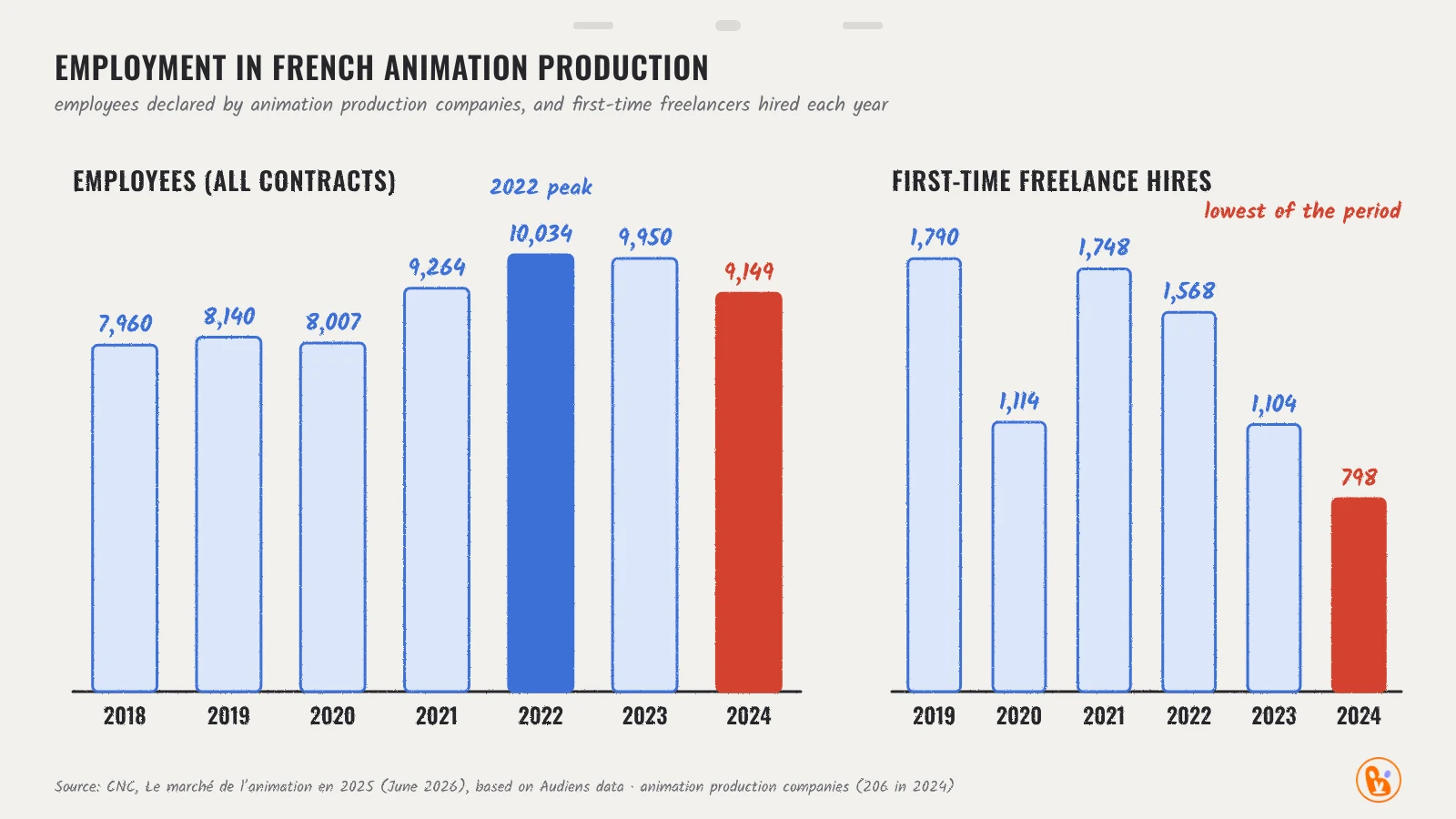
Over a longer period, the CNC counts 7,960 employees in 2018 and 9,264 in 2021 (CNC, full study, June 2026). So the sector is still bigger than before Covid. The drop shows most clearly in hours: freelancers worked about 6 million hours in 2024 against 8 million in 2022, and the number of those working more than 1,500 hours a year fell by 49.5% in two years, to 896 people. Many people are still in the industry, on shorter contracts with longer gaps.
The 507-hour threshold
The share of animation freelancers who worked at least 500 hours in the sector in 2024 was the lowest since 2019 (CNC, June 2026). France’s unemployment scheme for intermittent workers requires 507 hours over 12 months.
What about 2025 and early 2026?
The Audiens study on 2025 has not been published yet. Two more recent indicators exist, covering wider samples of companies, so their headcounts cannot be compared with the 9,149 above:
- Audiens monthly data on 532 companies show a decline from April 2023 to December 2024, then stabilization since January 2025: 7,611 employees a month on average in 2025, against 7,587 in 2024 and 8,134 in 2023. In March 2026 there were 7,723, against 8,638 in March 2023 (CNC, presentation, June 2026).
- Audiens’ study of the whole film and TV sector puts animated film headcount down 1% in 2025, after -5% in 2024 (Audiens, May 13, 2026).
The CNC sums it up: over 2025 and the first quarter of 2026, “employment nevertheless seems to be stabilizing.” Stabilizing does not mean recovering: the level is still the 2024 low.
Conflicting figures: provisional Audiens data announced 8,988 employees in 2024 (-10.5%) and 7.8 million hours (-16.3%), figures used by AnimFrance at the 2025 Mifa, the industry market held alongside the Annecy festival (AnimFrance, June 2025). In July 2026, NVO still quoted the provisional 16.3% drop in hours, alongside the final figure of 9,149 employees (NVO, July 2026). We use the final figures from November 2025: 9,149 employees and 8.1 million hours.
Why the animation industry is in crisis: the streaming bubble burst
For Adrien, it all starts with a bubble: during Covid, “the platforms needed to produce a lot to try to capture a monopoly on attention” (1:06:57). Then they realized none of them would buy out the others and subscribers would not pay for every service at once: budgets shrank and “Netflix cancelled a lot of projects” (1:07:25). The data back him up.
Streamers commission far fewer programs
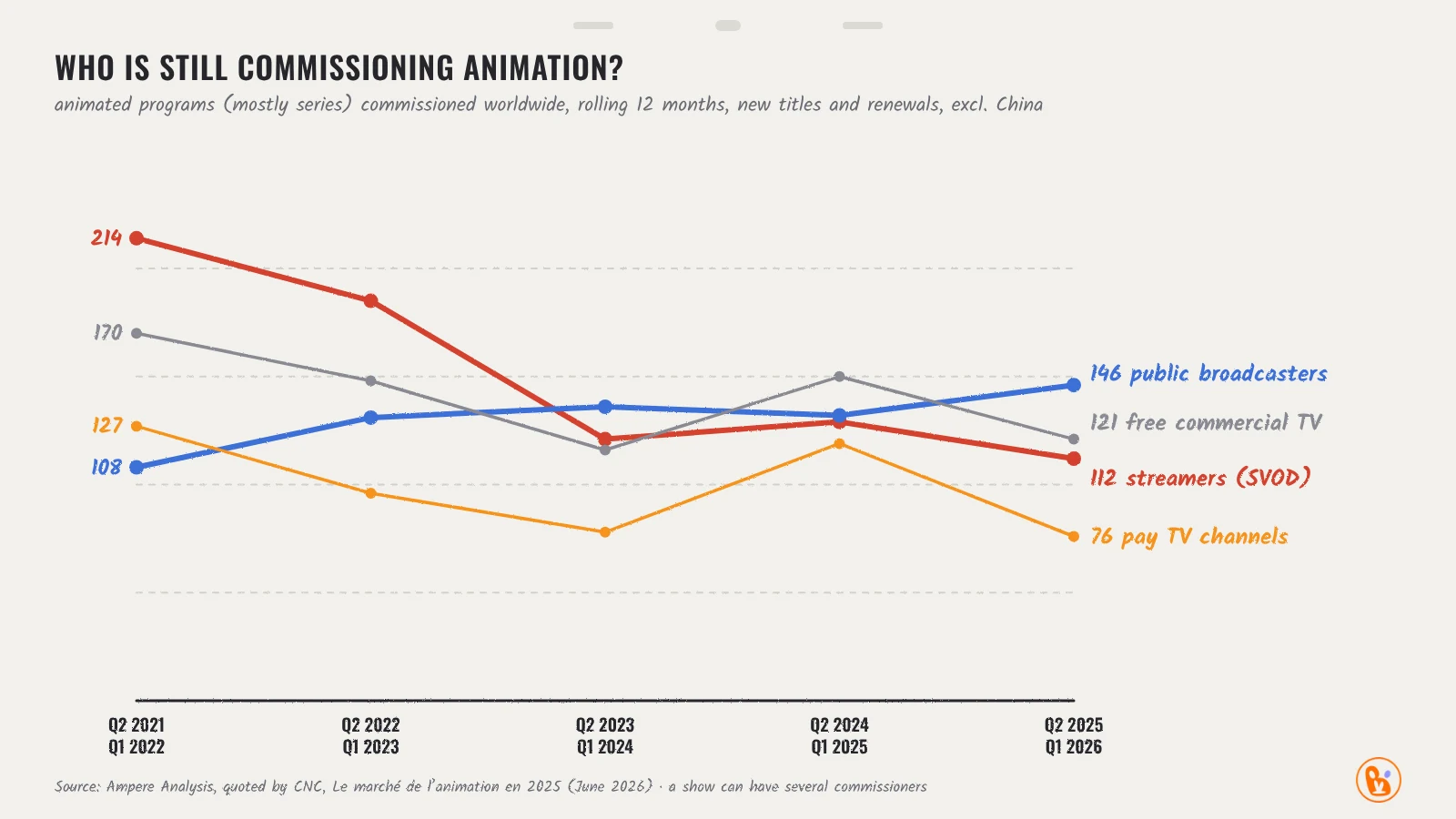
According to Ampere Analysis, quoted by the CNC, 593 animated programs were commissioned worldwide between Q2 2025 and Q1 2026, 10% fewer than a year earlier. Subscription streamers now commission only 112, against 214 in 2021-2022. In North America, commissions fell from 294 to 167 programs, mostly series, over the same period (CNC, presentation, June 2026).
In France, foreign service work fell off a cliff
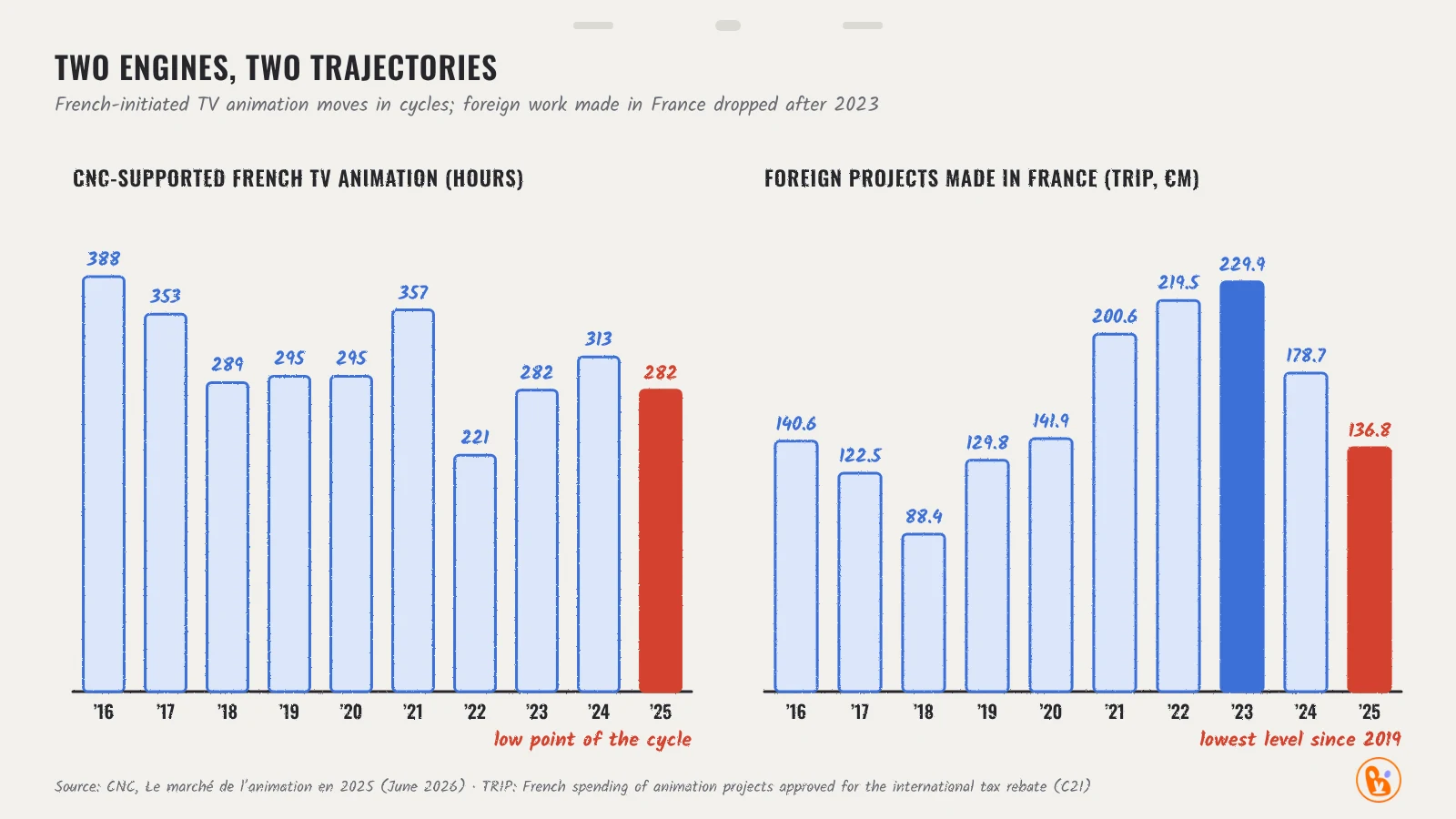
French studios run on two engines. French-initiated production supported by the CNC moves in cycles, in our reading of the figures: 313 hours of supported TV animation in 2024, 282 in 2025, below the ten-year average of 308 hours. Foreign projects made in France, measured through the French international tax rebate (C2I, or TRIP), dropped sharply: 39 projects in 2025 against 63 in 2023, and €136.8 million spent in France against €229.9 million. The CNC links this to falling worldwide commissions (CNC, summary, June 2026).
Foreign financing is on the same downward path: 19.5% of French animated series budgets in 2025, the lowest since tracking began in 2000, and not a single minority co-production in French animated features that year. The trade press adds other causes: streamers switching from growth to profitability, the 2023 Hollywood strikes, higher interest rates and, now, uncertainty over public funding ahead of France’s 2027 presidential election (3DVF, June 22, 2026). Adrien also mentions the economy, wars and public policies that changed abruptly (1:08:22).
He also points out who sets the pace: broadcasters and streamers decide release dates and pay the bills. A studio that turns down an impossible schedule watches the project go elsewhere (1:09:12). In the middle of the crisis, studios had to make those choices “to keep running and not go under,” and he does not blame them at all (1:12:42).
Animation studios in trouble: verified cases in France
Not every closure rumor checks out. Here are the cases documented by public sources.
- Cyber Group Studios (Paris): in receivership (redressement judiciaire, a court-supervised restructuring roughly comparable to Chapter 11) from late October 2024, liquidated at the end of April 2025 by the Paris commercial court (Satellifacts, April 28, 2025). The court rejected the takeover bids; the best one would have saved about a dozen jobs (3DVF, April 30, 2025). In the same article, the studio’s COO put the drop in streamer orders at “as much as 70% compared with before the crisis.”
- TeamTO (Paris, Valence): struggling and in court proceedings, the studio was acquired by Italy’s RIVA Studios with the Paris commercial court’s approval in early December 2024; most of the team was kept (3DVF, December 6, 2024).
- Technicolor: the group behind MPC, The Mill and Mikros Animation collapsed at the end of February 2025, with several French companies in the proceedings; 3DVF quoted an estimate of about 4,500 employees worldwide (3DVF, February 24, 2025). Mikros Animation was bought by Canada’s Rodeo FX, which said it would keep most of the team (press release, March 27, 2025).
- Andarta Pictures (Bourg-lès-Valence): production of the series Lana Longbeard stopped at the end of February 2025, about 80 people lost their jobs and the studio went into receivership at the end of March (3DVF, June 2025). It came out in August 2025, with Ankama as majority shareholder (3DVF, August 11, 2025).
- Supamonks (Arcueil), a 2D and 3D studio: liquidated on June 24, 2026 by the Créteil commercial court, at the request of its co-founders (Satellifacts, June 26, 2026). The number of staff affected was not made public.
At the 2025 Mifa, AnimFrance listed three liquidations, one receivership and three studio takeovers since May 2024 (AnimFrance, June 2025). A handful of visible failures, then, out of about 200 production companies. Most of the decline shows up elsewhere: in freelance contracts, fewer and shorter.
Animation industry layoffs in the US and beyond
France is not an isolated case: the same drop in commissions has hit studios, streamers and service companies everywhere.
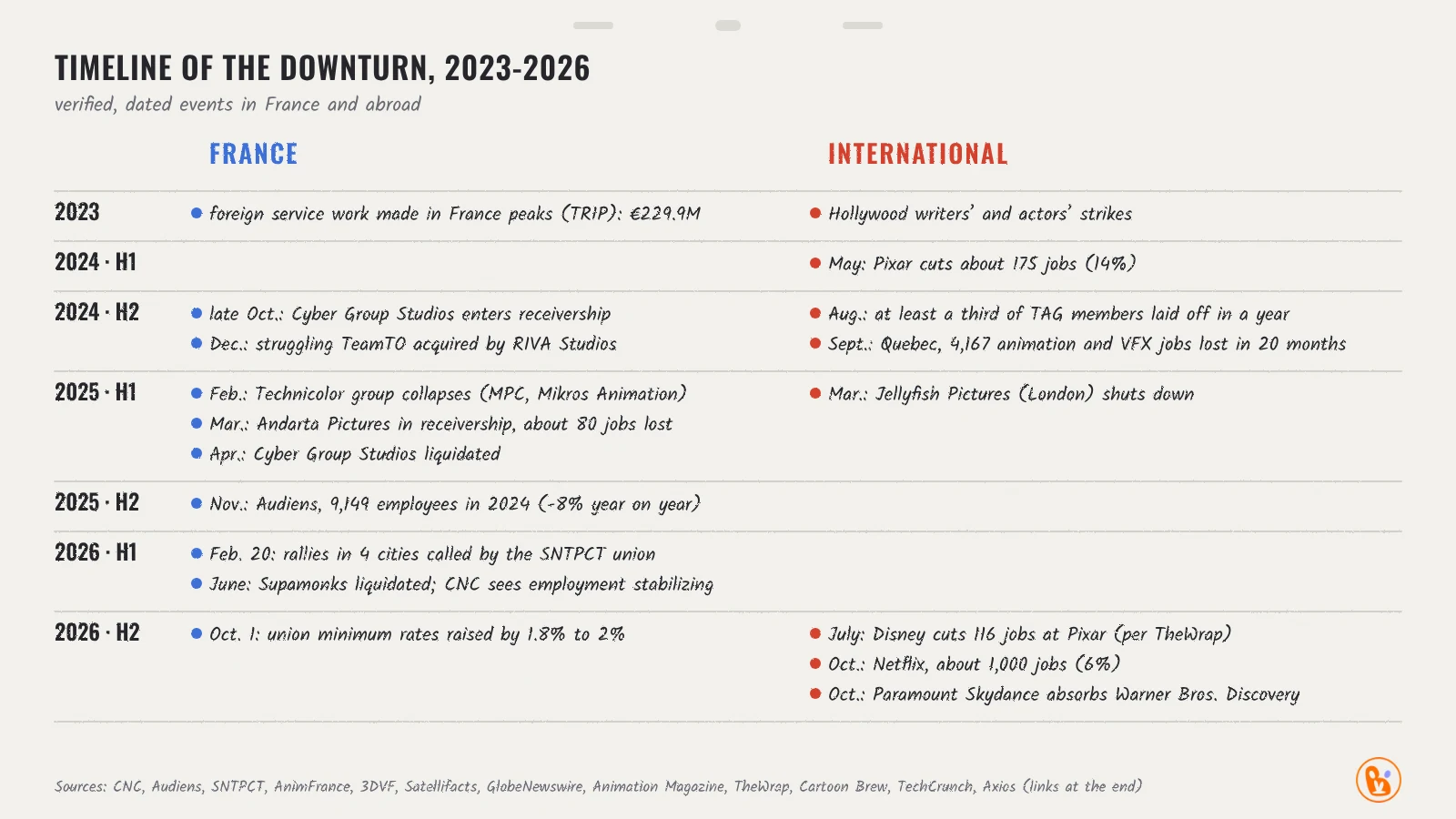
- May 2024: Pixar announces about 175 layoffs, 14% of its workforce, refocusing on features rather than streaming (Animation Magazine, May 2024).
- August 2024: based on internal surveys, The Animation Guild (TAG), Hollywood’s animation union with more than 6,000 members, estimates that at least a third of its members were laid off in the past year (TheWrap, August 7, 2024).
- September 2024: in Quebec, 4,167 animation and VFX jobs lost since January 2023, out of more than 8,000 at the end of 2022, according to the Quebec Film and Television Council (Cartoon Brew, September 3, 2024).
- March 2025: in London, Jellyfish Pictures pauses operations then shuts down, citing the long tail of Covid, rising costs and the US strikes; its 69 remaining staff are laid off (Cartoon Brew, March 24, 2025).
- July 2026: a new Disney round, with Pixar the hardest-hit studio: 116 jobs according to a source quoted by TheWrap (TheWrap, July 21, 2026); Cartoon Brew, also citing TheWrap, reported about 150 (Cartoon Brew, July 21, 2026). The WARN notice Pixar filed with the state of California covers 108 jobs (CinemaBlend, July 24, 2026).
- October 2026: Netflix cuts nearly 1,000 jobs, about 6% of its workforce, mostly in product, technology, legal and HR (TechCrunch, October 14, 2026); at least two animation executives are among them (Cartoon Brew, October 15, 2026). The same month, Paramount Skydance closes its acquisition of Warner Bros. Discovery, and the industry expects job cuts in numbers not yet known (Axios, October 6, 2026).
In the US, outsourcing adds to the pressure: a CVL Economics study, published with TAG, estimates that for children’s programming, at least 42% of what would have been spent in California now goes out of state or overseas (TAG and CVL Economics, April 2025). Some of it lands in France. Adrien says Disney has “a huge amount” made there, and believes France’s caution on AI and copyright plays a part (1:07:31). That is his analysis, not a measured figure.
Juniors and graduates: the first to be hit
This is the clearest finding. In 2024, only 798 first-time freelancers entered French animation, against 1,748 in 2021 and 1,104 in 2023: the lowest of the period. Newcomers now make up just 10.4% of freelancers according to the CNC, against 25.6% in 2019 (11% of all employees according to Audiens) (CNC, June 2026). In Audiens’ wider dataset, employees under 30 fell by 28% between March 2023 and March 2025, to 2,066.
Adrien put it bluntly to a viewer wondering whether the problem was them: it is “a struggle for pretty much everyone, and for all juniors in particular” (1:07:11). He had no trouble himself, thanks to a network and long projects back to back; the people who find work easily are “people who are already well established professionally” (1:07:29).
Too many graduates for the market?
That is his thesis: the junior jobs crisis “largely comes from” class sizes that have grown enormously (1:17:04). From memory, he puts it at about 3,000 graduates a year for about 10,000 employees; we looked at that reasoning and its limits in our article on AI and animation jobs. No official national count of animation graduates is published. The French animation schools network (RECA) tracks their plans: in 2024, 77% of final-year students surveyed wanted to work in France, against 91% in 2023 (quoted by the CNC).
Hiring has changed shape too. At the Mifa, Annecy’s market, the recruitment area went from about twenty stands in 2023 to three in 2026, and applications fell from 10,012 to 9,147 between 2025 and 2026. Some studios now follow profiles online all year round and reach out when a need arises (3DVF, June 22, 2026).
Once hired, juniors also pay the price on squeezed productions: overloaded supervisors no longer have time to give feedback, and juniors do not get the time to learn (1:00:41). And when many people are looking for work, some will always accept badly paid jobs on impossible deadlines, because they are “backed into a corner” (1:18:06). For the pace you can expect as a beginner, see our article on junior animator quotas.
Is AI behind the animation industry crisis?
Not at the start: the jobs decline began in 2023, when the streaming bubble burst. Even 3DVF, which expects AI to have a bigger effect in the coming months and years, notes it was not yet one of the causes when the crisis began.
Use is growing, though. The CNC’s AI barometer, run from April 7 to June 11, 2026 among 43 animation studios, shows that 79.1% have already tried AI tools, first to test ideas, then to assist with rotoscoping and compositing. Only 35.9% already see an effect. Among expected impacts, they cite changing skills (61.9%), weaker training for future talent (52.4%) and fewer jobs (35.7%). The CNC warns that the sample is small (CNC, presentation, June 2026).
Adrien, who had polled about a thousand people working in French animation, found very marginal professional use (see our article on AI). The two findings do not contradict each other: a studio trying a tool is not the same as artists using it daily in production. He does think advertising, motion design and illustration are probably hit much harder than animated film (1:10:57).
On the workers’ side, the SNTPCT union demanded on February 20, 2026 that generative AI be regulated with the unions before any experimental use in studios (SNTPCT, February 23, 2026). In the US, the TAG contract ratified in December 2024 by 76.1% of voters requires written notification when AI is used (Animation Magazine, December 2024).
Pay, protests, tax credits: what changed in 2026
The February 20, 2026 rallies
Answering a call from the SNTPCT union, animation and VFX workers gathered in Paris, Angoulême, Valence and Annecy while a delegation met the producers’ organizations. The union claims at least 300 participants; 3DVF, unable to verify that total, counted 60 to 70 people at the peak of the Paris gathering (3DVF, February 23, 2026). The demands: a catch-up on minimum pay (10.5% in the call to action, 11.2% on the day), paid public holidays backed by a 2,800-signature petition, an end to unpaid multi-day tests, and removing some wording from the collective agreement, such as “confirmé” (experienced), which the union says lets studios get around minimum pay (SNTPCT, February 16, 2026; SNTPCT, February 23, 2026). Employers were offering 1% at the time.
New minimum rates from October 1, 2026
Talks ended with amendment no. 21 to the French animation collective agreement (the sector-wide contract that sets minimum pay), signed on July 30, 2026: +2% for categories VI to III B, +1.8% for categories III A to I, effective October 1, 2026 (amendment no. 21). For an animator on a CDDU, the minimum goes from €662.86 to €676.12 gross per 35-hour week; an inbetweener moves to €483.89, an animation director to €881.82. That is far from the 11.2% demanded in February. In June, the SNTPCT had called an earlier employers’ counteroffer “indecent, to say the least.” The employers presented their new June 9 offer (1.8% and 2%) as take it or leave it, and the union left the decision to sign or not to its members (SNTPCT, June 2026).
Public support
- Domestic TV tax credit: France’s 2026 budget law (article 85) raises the cap for animated TV works from €3,000 to €6,000 per minute, to support high-budget shows made in France (Ficam, February 4, 2026; BOFiP, August 5, 2026).
- International tax rebate (TRIP): 30% of eligible spending in France for foreign projects, capped at €30 million (CNC).
- Direct support: in 2025, funding per hour of supported series hit record highs, €171,100 from the CNC and €222,300 from broadcasters. Together with public TV, they made up for the drop in foreign financing (CNC, summary).
Animation industry recovery in 2026: signals to watch
On the plus side: French employment stopped falling in 2025 and early 2026; public broadcasters commissioned 146 programs worldwide over twelve months, the most since 2021, and commissions of Western European programs rebounded by 12%; French animated features hit a record. Adrien feels it in the studio: “we’re really getting onto the slope where productions are restarting and things are picking up again. But it’s still very gradual” (1:10:10). He adds that even a full recovery may not be enough, given how many schools have opened. Earlier in the same livestream, he expected “a bit more work” in the coming year, but not enough to absorb all new graduates (1:07:59).
On the warning side: streamer commissions fell another 13% in a year, foreign service work in France is at its lowest since 2019, the Mifa will reassess by 2027 whether to keep its recruitment area, and US mergers point to more cuts. If the recovery holds, it will be gradual.
How to land animation jobs in 2026 as a junior
No advice creates jobs that do not exist. But the data and the mentors agree on what makes a difference when there are few openings.
1. A short, targeted reel, ready to send
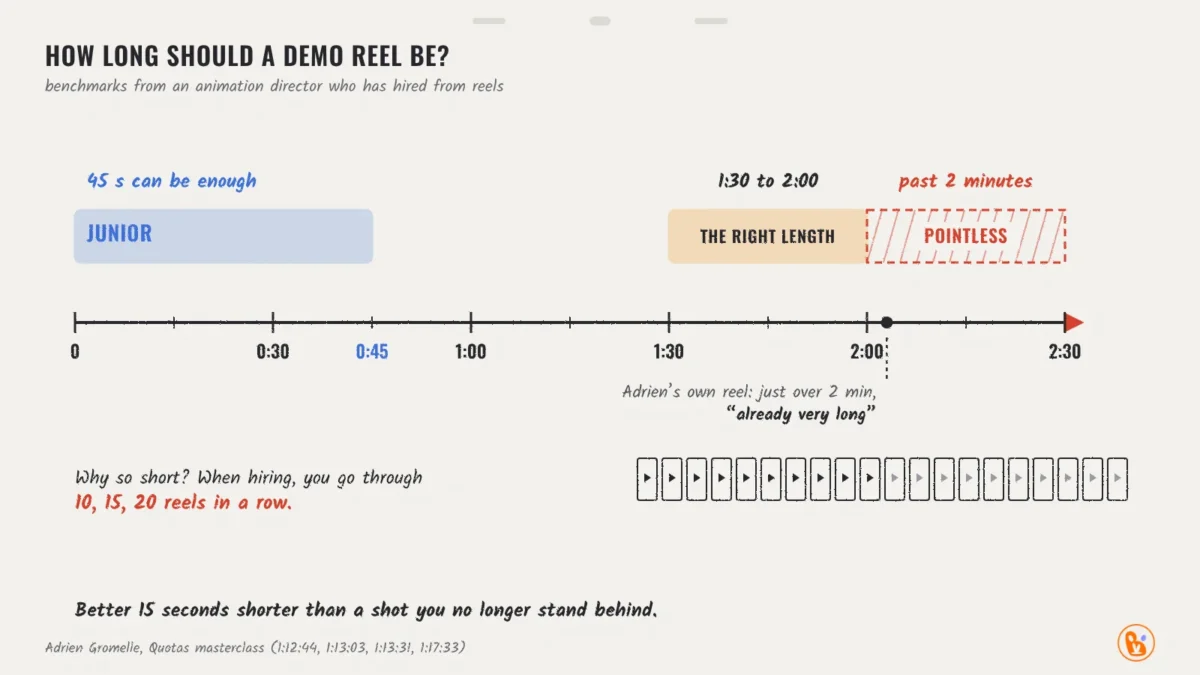
At the 2026 Mifa, 9,147 applications were filed for a recruitment area down to three stands, and some studios now scout profiles online all year. Your reel has to exist at all times, up to date, ready to go the evening a position opens. Adrien Gromelle gives his benchmarks in his masterclass on quotas: 1:30 to 2:00, and 45 seconds can already be enough for a junior (1:12:44). Above all, only include shots you stand behind (1:13:09).
2. Build your network before you need it
Adrien credits his own stability to his network. It has to be built before the job hunt: former classmates in studios, internship supervisors, festivals and markets like Annecy, industry meetups. Samy Fecih, a 3D animator, lead and animation director, mentions for example the Bring Your Own Animation evenings in Paris, where professionals give free feedback on the animation you show them (1:00:26). Feedback from a pro is also a contact. And before accepting a job, use that network to ask people who worked at the studio what it is like (1:18:42).
3. Be versatile without spreading yourself thin
Long contracts are rare now: only 896 freelancers worked more than 1,500 hours in 2024. Being able to switch between types of production helps you string jobs together:
- 2D cleanup and assistant work, a real way in according to Adrien.
- Small teams, in ads, short-form series or games: on a small team, Adrien points out, you don’t have someone for every role, so “you’ll need to be very versatile” (40:15). These are not guaranteed safe havens, each sector has its own cycles, but they are neighboring markets.
- 2D and 3D: being able to read a rig when you come from 2D, or draw your poses when you come from 3D, widens the range of jobs you can apply for.
Versatile does not mean average at everything. In 3D especially, production is split into separate roles, and Adrien is clear about it: “you have to be very specialized” (16:04). So keep one clear craft, the one your reel shows, and show around it that you can adapt.
4. Look beyond your own country, realistically
Commissions are rebounding for Western European programs and among public broadcasters, while North America stays low. Working on a foreign production, remotely or on site, can open doors, and English becomes a working tool. Adrien did not speak “a word of English” when he was selected for his mentorship at Disney, and sometimes got his point across better through drawing (02:22). For a remote interview, do not count on that.
5. Train for a specific role, with working pros
Studios that hire less hire more selectively. When openings are scarce, a reel that shows a bit of everything carries less weight than a reel built for the job you want, with shots at the level of what gets made in production.
Steve Alves, who worked at Illumination, on Arcane and at Ubisoft, put it this way on our podcast: specialized animation programs “bring so much more than a generalist school” if animation is what you really want to do (29:31). Samy sees it the same way. She trained online herself, at Animation Mentor, and recommends these programs because they let you “talk directly with professionals” who work on today’s productions (1:01:07).
That is the choice we made at Bouncing Ball: one track per craft (3D animation, 2D animation, rigging, lighting, video games), in small groups, with mentors currently working on feature films, for less than most campus schools charge. Every exercise is handled like a production shot, so it can go into a reel that speaks to studios hiring for that role.
6. Know your rights
When jobs are scarce, artists have little leverage to turn down impossible conditions, Adrien notes, because it is “not really full employment” (1:13:39). In France, a few benchmarks: the minimum for an animator on a CDDU is €676.12 gross per week since October 1, 2026; according to NVO, the collective agreement requires the contract to be handed over within 24 hours, and a studio was ordered to pay damages in Angoulême in early 2026 over late contracts (NVO, July 2026).
And keep a project of your own
Adrien agrees with a viewer about one effect of this period: in reaction to generated images, a desire for more personal, simpler projects made by small teams (1:18:04). A finished, distinctive personal shot feeds both your reel and your network.
In a nutshell
- The crisis is real: 9,149 employees in French animation production in 2024, against 10,034 in 2022, and 19% fewer hours.
- It is stabilizing in 2025 and early 2026, without recovering, according to the CNC and Audiens.
- The main cause is the end of the streaming bubble: 112 programs commissioned by streamers over twelve months, against 214 in 2021-2022, and foreign work made in France down from €229.9 million to €136.8 million between 2023 and 2025.
- Juniors are hit hardest: 798 first-time freelancers in 2024, against 1,748 in 2021.
- AI did not cause the crisis, but 79.1% of the animation studios surveyed by the CNC have tried it.
- To get through it: a reel that is always ready and built for one role, a network you maintain, specialized training with working professionals, and English.
Your junior action plan
Five things to start this week:
- Update your reel
Under 2 minutes, shots you stand behind, a working link, contact details visible. - Reach out to five people
Former classmates, internship supervisors, instructors: news, not a job request. - Show a shot to a pro
Meetup, festival, mentor: one precise note beats ten likes. - Widen your targets
Cleanup, ads, short-form series, games, European productions. - Check your rights
Current pay scale, a written contract, feedback from people who worked at the studio.
This plan does not guarantee a job. It improves your chances of being the person who gets the call when one opens.
The charts are original Bouncing Ball creations, built from the sources given at the foot of each chart. Figures are current as of the article’s update in October 2026.
FAQ
Why is there an animation industry crisis?
Mainly because streaming platforms cut their commissions after the Covid-era production bubble. According to Ampere Analysis, quoted by France’s CNC, streamers commissioned 112 animated programs (mostly series) worldwide between Q2 2025 and Q1 2026, against 214 in 2021-2022. In France, work made for foreign productions dropped from €229.9 million of spending in 2023 to €136.8 million in 2025, and French-initiated production is in a low cycle. The result: 9,149 employees in French animation production in 2024, against 10,034 in 2022, according to Audiens. Juniors are hit hardest, with 798 first-time freelancers in 2024 against 1,748 in 2021. Employment has been stable since 2025, without recovering. In the US, layoffs at Pixar, Disney and Netflix, and the Paramount Skydance takeover of Warner Bros. Discovery, show the same pressure.
Is it hard to find animation jobs in 2026?
Yes, especially a first job. New entrants are at their lowest, and studios hire more through their networks or by scouting profiles online. Adrien Gromelle sees established profiles finding work, and productions restarting slowly, but not fast enough to absorb all graduates.
Is AI causing animation industry layoffs?
Not at the start: the jobs decline began in 2023 when streamers pulled back. AI use is growing, though: according to the CNC’s 2026 barometer, 79.1% of the 43 animation studios surveyed have tried it, but only 35.9% already see an effect.
How many people work in animation in France?
Animation production employed 9,149 people in 2024 according to Audiens, all roles combined, including 7,666 freelancers. Animation roles in the strict sense account for about 2,700.
How can I land my first animation job during the downturn?
Keep a short reel ready to send, built for the job you are after. Build your network before you need it, widen your targets (cleanup, ads, series, games, European productions) and work on your English. To improve, choose specialized training in your craft, where working professionals review your shots.
Everything you have just read, our mentors put into practice every day on feature films. To go further, they guide you in small groups through our professional training programs, shot by shot, with the standards of a real production.
Sources
All sources were accessed in October 2026. Most sources from France are in French.
Studies and official data
- CNC, Le marché de l’animation en 2025, presented June 24, 2026: full study, summary, presentation (including the AI barometer and Ampere Analysis data).
- Audiens, L’emploi dans la production de films d’animation, 2025 edition, November 2025.
- Audiens, Employment in film and TV 2019-2025, May 13, 2026.
- AnimFrance, Mifa 2025 presentation, June 2025.
- Amendment no. 21 to the French animation collective agreement, 2026 pay, signed July 30, 2026.
- CNC, International tax rebate.
- Ficam, 2026 budget bill: key changes to tax credits, February 4, 2026; BOFiP, audiovisual tax credit, August 5, 2026.
- The Animation Guild and CVL Economics, Reclaiming California’s Role in Global Animation, April 2025.
Unions
- SNTPCT, call to rally on February 20, 2026, February 16, 2026; statement of February 20, 2026, February 23, 2026; 2026 minimum pay negotiations, June 2026.
Press
- 3DVF: recruitment at the Mifa, June 22, 2026; February 20 rallies, February 23, 2026; Cyber Group Studios, April 30, 2025; Technicolor, February 24, 2025; TeamTO, December 6, 2024; Andarta labor court case, June 2025; Andarta exits receivership, August 11, 2025.
- Satellifacts: Cyber Group Studios, April 28, 2025; Supamonks, June 26, 2026.
- NVO, Précaires mais de plus en plus mobilisés, July 1, 2026.
- Rodeo FX, Mikros Animation Joining Creative Company Rodeo FX, press release, March 27, 2025.
- Animation Magazine: Pixar, May 2024; TAG contract, December 2024.
- TheWrap: Animation Anger, August 7, 2024; Pixar Lays Off Staffers, July 21, 2026.
- Cartoon Brew: Quebec, September 3, 2024; Jellyfish Pictures, March 24, 2025; Pixar, July 21, 2026; Netflix, October 15, 2026.
- TechCrunch, Netflix to lay off 1,000 staff, October 14, 2026.
- CinemaBlend, Pixar WARN notice, July 24, 2026.
- Axios, Paramount closes deal for Warner Bros. Discovery, October 6, 2026.
Bouncing Ball masterclasses quoted (in French)
- Adrien Gromelle, AI vs Animation; Every production is a miracle; Starting a shot the Disney way.
- Samy Fecih, Testing a rig in animation.